Friday, April 3, 2015

The Minoans: Aegean Decline and the Bronze Age Collapse

While we have looked at many aspects of Minoan life during both the OT and NT periods, we have not looked at life during their cultural decline. The splendor of the NT period, with its large temples, elaborate jewelry, and expansive colonies was surely the peak of bronze age Crete. The Theran eruption heralded a new period, one in which the labyrinth at Knossos was the sole temple-palace on the island. The shining jewel in the Minoan crown, Thera, had been utterly annihilated and abandoned. Knossian dominance might have even allowed them control of the entire island, but it is unknown. Depending on the dating of the eruption, Knossian domination was either a brief period between 1,470-1,380 in the final waning hours of the Minoan culture, or its most vibrant golden age between 1,600-1,380. Both pictures paint the city of Knossos as a central facet of the unique Minoan culture during the LBA, but its stability was in the end an impossible task. The world around them had changed, and even their “wooden walls” could not save them.

By 1,400 BCE Minoan pottery began to become rigid and formal, it had essentially started to become Mycenaean. Specific scenes became standardized, and copied across the island. The patronage of the nobility was no longer the source of creativity that it once was. Cultural novelty still occurred, as the new Knossian Palace Style pottery proliferated during this period. Palace style and rich Mycenaean pottery were still made by potters specifically for the wealthy, and new forms of pots which show distinctive Mycenaean traits appear in the record. Helmets and shields begin to more heavily appear on pottery during this period, showing the rising importance of warfare in art.

Reconstruction of the palace of Knossos, from httpearth-chronicles.runews2013-09-23-51570

The post-1,400 BCE switch in general pottery styles was simultaneous in an island wide switch to Linear B (and Proto-Greek) from Linear A (the Minoan language). These pieces of evidence suggest that the island was conquered by mainland rulers, and its elite was replaced by ethnic Greeks. On the mainland this period after 1,400 BCE was a renaissance: instead of a single city's dominance (Knossos), the mainland was controlled by a series of walled cities ruled by kings. These kings extended their control into the hinterlands, marrying far off families to secure political alliances and gave patronage to local artists be it pottery, metalworking, or fresco painting. Over the course of 200 years Mycenaean culture and people would usurp the trading empire of their ideological ancestors throughout the eastern Mediterranean. While it is impossible to know which Minoan settlements were destroyed by the Mycenaeans and which weren't, what is assured is that after 1,400 BCE Mycenaean culture had come to Crete, and it had come to stay.

The Great Fire of 1,380, and the 14th Century BCE

The Knossian period on Crete was brought to an end by a giant fire, which destroyed the labyrinth at Knossos around 1,380 BCE. While people continued to live in the town around the gutted labyrinth, the temple proper was abandoned. Around 1,380 BCE the city of Thebes on the mainland was also destroyed, this was a perilous time for Mycenaeans and Minoans alike. After the great fire, the art of elaborate seal carving began to die out on Crete, and temples were no longer built on the island. There were many reasons why such an ancient practice would finally end, most plainly it is an example of the lack of a strong political will. The building of palace-temples took a king with good international trading connections, a good supply of stone and manpower, and more importantly time and stability. These pillars of megalithic construction were no longer present on the island.

Another significant factor was a general shortage in materials. By the LM period most of Crete's native cedar forests had been depleted through its kings' large construction projects. Palace-temples required large amounts of wooden rafters, making their construction prohibitively high for the weaker rulers on Crete post-1,380 BCE. In addition to large structural changes, larnakes were introduced and became widespread during this period. A widespread change the method of burial points to a much larger shift in the Minoan mindset, considering these beliefs do not change flippantly. These new Minoans buried their dead differently, they lived in towns near the ruins of palace-temples, and their kings no longer used scribes (or if they did it was not on the same scale)...society had changed dramatically.

An aerial picture of the modern day ruins at Knossos

Minoan cities no longer built giant palace-temples to calcify their authority, and their artists no longer dominated the fashion of the eastern Mediterranean. By 1,300 BCE Linear B was used throughout the island, as well as Mycenaean pottery, sealings, and artistic styles. Minoan culture entered a serious decline, and between 1,380-1,100 BCE settlements across Crete become smaller, walled, and move inland. These post-temple settlements were designed solely to account for defense, violence prevailed and the Minoan culture was on the defensive. With the domination of foreign art and language, and beleaguered by pirates the Minoans were fighting a losing battle, by 1,000 BCE Minoan material culture had ceased to exist. Some historians have suggested that the influx of Mycenaean culture on Crete during this period is from refugees, and not from an invasion, but either explanation reveals a confusing period rife with instability.

A reconstruction of building P, storage/shipsheds, at Minoan Kommos, built around 1,360 BCE. Even without temple-palaces, large scale architecture, wealth, and power did not disappear. Each bay is 4 meters high and 40 meters long, and was found to hold many short necked amphoras, deeply connecting this building in coastal Kommos to inter-city or international trade. It is also hypothesized that the bays may have at times held ships

Exquisite gold necklace attachments in the shape of bulls heads, 1,350-1,300 BCE, from Agia Triadha

The end of the palaces also meant the end of organized religion on Crete, and after 1,380 BCE the primary cultic focus of many Minoans' lives had reverted back to their traditional cave cults. Peak sanctuaries had most died out by this period, but considering cave sanctuaries are harder for pillagers to find it is sensible that these would become the dominant areas of stored iconography. The Minoan religion could not survive foreign influence either, and around 1,200 BCE even cave cults had died out. Aspects of the Minoan religion and mythology continued on in the hearts of their worshipers, influencing the origin story of Cretan Zeus as it was told in the 5th century BCE.

Reconstruction of a domestic shrine in house X of the southern area in Kommos, Crete, post palatial period (1,380-1,100 or 1,000 BCE), by C. Dietrich

The Trojan War and Sea Peoples, the 13th Century BCE

Peoples of the Sea” by Giuseppe Rava

By 1,300 BCE Mycenaeans had complete control over the Aegean, and by this period had large established colonies in Cyprus and on the Anatolian coast (with the centerpiece being the large city of Miletus). This is the century of Mycenaean hegemony. While Greco-Roman scholars placed the Trojan War in this period (by counting successive generations) placing mythical accounts of Mycenaean warfare in this century was if anything a lucky guess. In the middle of this century the rulers of Mycenae cemented their power through massive construction projects, in effect redefining their city's political and historical narrative. Around 1,250 BCE they extended the citadel so as to include Grave Circle A. They built a wall around the Grave Circle, repaired fallen stele dedicated to ancestral nobles, and built a small shrine at the site. The mid 13th century rulers of Mycenae intended to connect their current stable government to the glorious historic kings of 16th century. The 13th century rulers intended to change the narrative: those old kings would no longer languish in run-down burials outside the citadel, but were the venerated ancestral heroes whose ethereal power now propelled Mycenae's 13th century fortune. The city's glorious past was connected to their present, but this was not enough. The huge and imposing Lion Gate was built to crown the main gate of the city, and current kings were interred in beautiful tombs like the Treasury of Atreus. On Crete, small settlements moved further inland to escape sea raids, while on the mainland their cultural progeny proliferated.

A late Minoan jug, 1,300-1,200 BCE

A late Mycenaean figurine, ca. 1,200 BCE

Around 1,200 BCE there was yet another collapse on Crete, many places were burned and destroyed. This collapse was most likely caused by waves of Sea Peoples. After this series of raids, many old Minoan sites were finally abandoned, being left in obscurity forever. It is possible that the place name Minoa was introduced into Gaza around this time by the Peleset tribe (one of the groups considered Sea Peoples). The Peleset had fought with the Egyptians, forcing them to concede Gaza for the Peleset's settlement. The Sea Peoples as a whole may have included Cretans and Mycenaeans, who would have brought their native place name.

A map of cities destroyed around 1,200 BCE

 A reenactor from the Koryvantes group as a member of the Sherden tribe of Sea Peoples

Around 1,200 BCE on the mainland the then Wanax of Mycenae built an underground cistern which would have greatly helped the city survive a siege. This period was calamitous for Greeks, around 1,200 BCE there is a general decrease in the number of Mycenaean sites: 9/10 are lost in Boeotia, and 2/3 are lost in Argolis. It is the end of the Mycenaean palace culture, and many Mycenaeans fled to their colonies: to Cyprus, the Aegean islands, and to the Anatolian coast.

“This collapse was not instant and was not total. In addition to the individual sites, there are several elements of continuity; material culture remains mostly the same as before for another century or more (not only continued Mycenaean material culture but Minoan material culture as well), shipbuilding technology, ceramics, and agricultural practices are not disturbed in the slightest.” - Daeres, in r/askhistorians

While the flourishing native culture of the palace period dies out, the great power centers of the Greek world do survive through this period, as Mycenae and Tiryns both held their wealth and power of previous eras. Throughout the 12th century BCE Mycenaean culture generally continues albeit with new cultural influences. So called “Barbarian ware” became popular throughout the Mycenaean world during this time, and while it was actually a native invention it generally shows a down-ward trend in elaborate artistry. In addition cremation becomes slowly more popular, and became the norm in the 8th century BCE.

A map of some cities destroyed and those which survived the crisis around 1,200 BCE. All of the directional arrows are entirely speculative and should be disregarded

The Sub-Minoan and Sub-Mycenaean Period, the 12th and 11th Centuries BCE

Between 1,200-1,100 BCE, while Mycenaean material culture continued its political power collapsed. Pottery and decorative styles changed rapidly while fine craftsmanship and art declined. The citadel at Mycenae proper remained occupied throughout this period, the Wanax was able to hold on to some amount of power through the region's decline. This desperate struggle for control would not last, and by 1,100 BCE the palaces, their titles, and their writing had all died out on both Crete and Greece.

Even in areas which suffered better through the collapse, the decline in artistic quality is evidence. A chlorite vase inscribed with Cypriote or early Phoenician, 1,100s BCE, Mycenaean Cyprus

The only remnants of traditional Mycenaean culture were Achaean settlements on Cyprus and at Al Mina on the Syrian coast. The longest lasting aspect of Mycenaean culture was their dialect of Proto-Greek which was used on Cyprus well into the iron age. While the glory of Minoan culture had faded, elements of Minoan artistic style and pottery continued til around 1,000 BCE. The final place which expressed an identifiable Minoan culture is the refuge settlement of Karfi, on Crete, which continued Minoan traditions until around 1,000 BCE.

A figurine considered a household goddess, found at Karfi during the Sub-Minoan period. It notably includes the Minoan sacred horns

While the zenith of Minoan-Mycenaean civilization clearly had passed, the depths of poverty and despair involved in these changes is not a simple matter to assess. Sloppier pottery need not imply poorer people, although it might. Smaller dwellings would suggest lower levels of well-being, but simply less careful construction need not. The magnitude of the populations surviving to retreat away from the coast is difficult to discern from the artifactual remains, and the record of the pull-back is incomplete, so we have little firm, direct evidence of whether the relocations were made by shattered remnants of populations or more or less intact populations.” - Donald W. Jones

Culture always continues, even as specific identifiers such as Minoan drop off. There was always a nobility, even during the dramatic changes between 1,200-1,000 BCE, and these nobles still fought in bronze armor and desired nice pottery. By 1,050 BCE a new style of pottery became popular, called Protogeometric. It was invented in and popularized by Attica, specifically Athens, which had quickly recovered after the BAC. After its Attic invention, it quickly spread to the Peloponnese and Euboea. While Peloponnese artisans copied the Attic style, Euboean artisans (centered at its chief city of Lefkandi) developed their own style using the pendent semicircle. This Lefkandian style was then spread and copied by Cycladic and Thessalian potters. Protogeometric pottery was also spurred on by new developments in technology, such as using faster wheels (allowing potters to make thinner walls), and using compasses (allowing perfect circles). While some iconic forms of Mycenaean pottery such as the stirrup jar and the squat alabastron disappear, other forms of pottery survive into the Protogeometric period, simply taking on a new aesthetic veneer.

A Minoan protogeometric style pot, from the Sub-Minoan period, 1,100-1,000 BCE

Certain areas continued more ingrained Mycenaean traditions: Crete and Thessaly continued building tholos tombs into the early iron age, and the Argolid continued the LBA burial style of inhumation. Attica not only championed new styles of pottery, but also the imported iron age practice of cremation. While the general economy of farming, weaving, metalworking, and potting continued throughout these centuries, they were at a much lower output than previous eras. Items made in towns in this period were designed mostly for local use, and painted with local styles. Overall, there is a trend toward simpler styles in art Protogeometric art.

A Greek protogeometric style cup with three circles, 1,050-900 BCE

Argos and Knossos were continuously occupied during this period, and many cities were able to rebound quickly such as in Attica, Euboea, and central Crete. While the elite could recover a semblance of wealth and power, the lives of the poor generally remained unchanged as in previous centuries. An illuminating example of how a city dealt with the troubles of this era is seen in the story of Nichoria in the Peloponnese. It was abandoned in 1,075 BCE but re-emerged 15 years later as a village. This scaled down version of the town included 40 families with each having enough good land for both farming and cattle grazing. In the 10th century BCE a building similar to a megaron was built on top of a ridge overlooking Nichoria, likely inhabited by a chieftain. This building was made of a similar material to other houses in the town (mud with a thatched roof) and while it could also be a storage or religious building, it was probably a mini-citadel. The political heart of the town had been reformed around the chieftain's longhouse.

Mycenaean clay sculpture of a temple, ca. 1,100 BCE

As society changed local regions became more independent. Local social structures re-organized around kinship and oikoi (households), creating the seeds for the rise of the polis. Most significantly, the biggest societal change came not from the Sea Peoples but from the introduction of iron. From around 1,050 BCE small iron industries pop up across Greece, as the technology is imported from Cyprus and the Levant. This new metal allowed a leader to make cheap edged weapons for their mass of soldiers unintentionally it had democratized the cutting sword. In previous eras, bronze swords were expensive and reserved for the elite, that social structure had drastically changed. Within 150 years (by 900 BCE) almost all weapons in graves were iron, as nobility across the Greek world had universally adopted the stronger metal in all aspects of life.

“It takes till around 1050-1000 bce for many of these sites to be re-inhabited, and for the population of Greece to start visibly growing again.” - Daeres, in r/askhistorians

The Heroon at Lefkandi, and the 10th Century BCE

By the 10th century BCE most Greeks lived in small settlements, surrounded by isolated farmsteads. Some settlements had chieftain houses, such as at Nichoria in the Peloponnese and Lefkandi in Euboea. These nobles were no longer buried in great tombs, but cremated and buried with iron weapons. While political society had become re-organized at a smaller level, some long distance trade never stopped as Baltic amber continued to be imported from the far north. The nobles who could afford such exotic items still had wealth, and still desired exquisite objects.

The largest building from this era is the chieftain's long house at Lefkandi, in Euboea. It is called the “Heroon”, and was a long narrow building 150' long by 30' wide. It included two burial shafts, one with four horses and the other with two humans. The two people were a cremated male with iron weapons and an inhumed woman with gold jewelry. From the scale of the building the chieftain of Lefkandi was probably the most powerful ruler in Greece at the time, a hypothesis supported by the spread of Lefkandian pottery and colonists throughout the Aegean. By 900 BCE the rulers of Lefkandi had even reestablished trading connections with the Levant, continuing to aggrandize their political power.

A diagram of the Heroon at Lefkandi, in Euboea

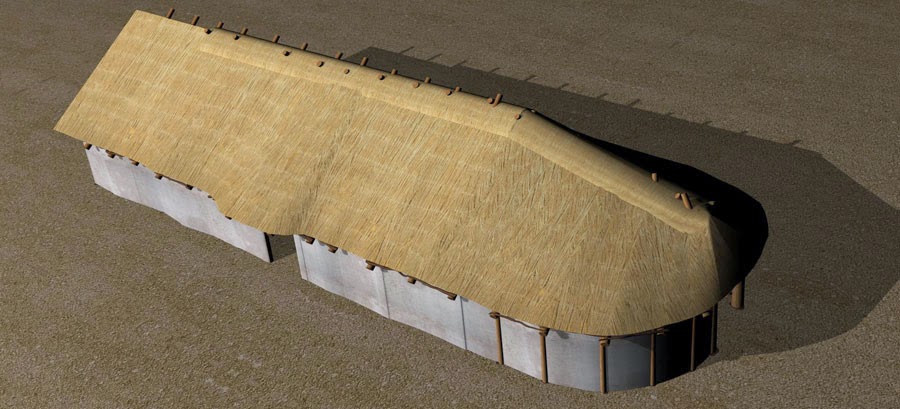
A reconstruction of the building of the longhouses at Las Camas near Madrid, an early iron age site with a similar structure to the Heroon, phase 1

A reconstruction of the building of the longhouses at Las Camas near Madrid, an early iron age site with a similar structure to the Heroon, phase 2

A reconstruction of the building of the longhouses at Las Camas near Madrid, an early iron age site with a similar structure to the Heroon, phase 3

A cross section of the reconstructed longhouse at Las Camas

Looking at the two burials at the Heroon in Lefkand, they both are exquisite. The man's bones were placed in an imported Cypriote bronze jar which included hunting scenes on the cast rim. The woman had gold coils in her hair, gold rings, gold breast plates, and an heirloom necklace. The necklace, while buried with this woman in the 10th century BCE, was made 200-300 years previous (around 1,150-1,250 BCE) either in Mycenaean Cyprus or in the Near East. The woman also carried an ivory handled dagger. The sacrificed horses had iron bits in their mouths. The entire structure was most likely created to house the burial, or had been originally the chieftain's house which had become his burial plot. Sometime after the burial the building was destroyed, the site being turned into a general burial plot for the local nobility. Rich members of Lefkandi were cremated and buried close to the east end of the building until around 820 BCE.

A terracotta funerary centaur figurine from Lefkandi, Euboea, ca. 900 BCE

A map of dark age Greece ca. 900 BCE (this picture is actually very large, so save it and zoom in if you need a closer look)

A reconstruction of EIA (early iron age) Greek warfare

While the Heroon was built at Lefkandi, Mycenaean Cyprus had also rebounded some from the collapse. This is an agate ceremonial scepter head which was originally set into an iron shaft, made ca. 950 BCE on Cyprus

The Archaic Period, The 9th Century BCE and Beyond

The iron age signaled the change and creation of new traditions, such as with the elite burial and architecture at Lefkandi. Free standing temples were built, such as a temple to Hera at the summit of the citadel of Mycenae. Early recorded wars show the development of serfdom and the emergence of a new political surface to the Greek world.

The re-emergence of potent states arguably lies around 800-700 bce. Many areas see lots of strife due to competition between different aristocratic families and clans, who fought over the title of basileus. Writing is re-introduced by the Phoenician script, which is then adapted for the Greeks. But recover they did, even though it took a long time and even though entirely new problems emerged in the wake of the recovery.” - Daeres, in r/askhistorians

Sparta was first settled around 1,000 BCE, near the larger Mycenaean survivor of Amyklae. In the first half of the century the Temple to Apollo was built in Amyklae which incorporated the older shrine to Hyakinthos (a tumulus of Mycenaean origin which had become a sacred place). Sometime between 800-750 BCE Sparta conquered Amyklae, reducing them to a free people (but not Spartan citizens) within the Spartan Kingdom. Sparta quickly went on to conquer the rest of Laconia. After locking down their surrounding area they conquered Messenia after a brutal war between 743-724. This resulted in reducing the surviving Messenians to serfdom.

A map of the emergent Spartan Kingdom, ca. 700 BCE

A middle Geometric style pot, 850-760 BCE

A geometric style pot with female mourner celebrants

The old order had changed, ancestral powers like Mycenae and Pylos were no more. In their place, weaker cities like Athens could hold onto power by surviving the deluge, cementing their power by inventing and popularizing new artistic styles. Other weak states like Sparta reformed itself into a military meritocracy, and had to re-institute large scale slavery to hold on to power. In 776 BCE the Olympic Games were establish, these new iron-based Greek cities had begun to culturally synthesize. Each city-state eventually accepted these inter-state competitions, along with its internationalist moral codes such as the recognition of foreign athletes and its enforced cease fires. It was the beginning of a new Greek culture.

An early archaic Greek helmet from Tarento, Italy

A reconstruction of that helmet by the Koryvantes reenacting group

A reconstruction of an archaic hoplite by the Koryvantes group, ca. 800 BCE

A reconstruction of an archaic hoplite by the Koryvantes group, ca. 800 BCE

A reconstruction of an archaic hoplite by the Koryvantes group, ca. 800 BCE

In the early 8th century a version of the Iliad was written down by Homer, and as the century progressed a native variant of the Phoenician alphabet would be adopted by merchants and eventually the entire literate population, most likely starting in Euboea. This period would come to be dominated by iron and Phoenician trade, rather than by bronze and bureaucratic palace scribes.


“It is believed that the whole of Homer may have been passed on by oral tradition for several generations before being written down in the 9th century BCE. If this seems unlikely, it is recorded that in January and February 1887, a Croatian minstrel recited from memory a series of lays amounting to twice the combined length of the Iliad and the Odyssey.” - Rodney Castleden

By the 9th century BCE Greek society had remarkably changed. This is a model of a circular shrine, and contained figurines of a goddess, it was made in the late 800s BCE, and found at a tomb near Arkhanes, Crete

As the population of cities began to increase once again, some spread their culture by founding colonies in the Aegean and southern Italy. Some of the first cities to found colonies were the ancient rivals of Chalcis and Eretria, both on the island of Euboea. Beginning in the early 700s BCE Chalcis founded a colony in the bay of Naples, and then the city Naxos on Sicily. The rulers of Eretria must have formulated some response, the two would continue to compete viciously each entangling themselves into a network of Greek alliances. These two grand coalitions would come to fight each other by the end of the century in one of the earliest recorded wars, the Lelantine War (710-690 BCE). Chalcis and Eretria were strictly fighting over the fertile plain between their cities, but as each side drew in their allies soon the whole Greek world was at war with itself. Chalcis and its allies (such as Sparta and Corinth) won, destroying Eretria. This helped the entire coalition as Sparta gained more land in the Peloponnese, and the other primary ally Corinth expanded its colonial efforts. By the end of the 8th century BCE, not only had new states emerged from Greece but they began to found colonies once more, wars began to stretch across the whole of the peninsula.

The Lelantine plain, the heartland of Euboea. The early archaic city of Lefkandi sits at the mouth of the Lelas river, with the archaic rivals Chalcis and Eretria on the left and right of the usufruct

Map of the alliances which fought in the Lelantine War, between 710-690. Red: Chalcis and its allies (mainly Corinth and Sparta). Blue: Eretria and its allies (mainly Megara, Argos, Messenia, and Miletus)

While the politics of the era had changed, more integral aspects of culture and warfare had remained unchanged. The Geometric Age Greeks, just as their Mycenaean ancestors, were ruled by slaver elites in competitive city states. Each city would found and then fight over their colonies. The dramatic tablets from the 13th century BCE Hittite Empire show a similar political situation: the mainland and the colonies were connected by thoroughly intermarried elite families who rivaled with foreign rulers and mercenaries for power. While many aspects of culture had changed, the political situation of Greek cities had not.

An early archaic hoplite reconstruction, without a crested helmet, by the Koryvantes group

An early archaic hoplite reenactor from the living history association Hetairoi

A reconstruction of an archaic hoplite

Another reconstruction of an archaic hoplite

Other coastal regions of Greek besides Euboea were interacting with Mediterranean trade as well, leading to cemeteries throughout the 8th century BCE becoming richer once again. Burials began to include rich imports from the near east, Egypt, and Italy. Greek potters began to export their wares along the old trade routes, to the Levantine coast and to north central (Villanovan) Italy. A large amount of well made pottery from the era are found on funerary kraters. An aristocrat would pay to have a large amphora made and painted with a funerary scene, it would be placed as if it were their grave stele. The popularity of this new tradition increased along with its new painting styles, a native 8th century invention. Eventually these scenes became more complex and by the end of the century pottery had become less rigid, more elaborate, and began to include scenes based on epic poetry.

The Hirschfeld krater, showing a body laying out in prothesis surrounded by mourners, made in the Attic style between 750-700 BCE
Detail of the Hirschfeld krater

Detail from the Dipylon krater, a geometric krater also showing prothesis and mourners, 900-700 BCE

During this century iron tools and weapons had increasingly better quality, in conjunction with new supplies of tin and copper which were once again reaching Greek smithies. Through the 8th century BCE iron continued to have a humungous impact of peoples' lives. Ever since its widespread introduction in the 10th century BCE it had forced society to reform, armies could now more easily be fielded equipped with powerful weapons. Previously in the bronze age, swords were only owned by the nobility, but now that swords could be supplied on a larger scale any noble with enough money could easily raise a strong force. Society had to adapt to this change and the simplistic top-down approach of earlier eras could no longer support strong societies. Local units could hold much more power, and their cohesion required truly negotiating between factions of equals. While the rich still controlled the land, power was no longer centralized in a Wanax, Temple, or 9th century chieftain, but in a cabal of aristocrats. It was the birth of the Greek polis system.

Late geometric style pyxis with horses on the lid, 760-700 BCE

A late geometric style pyxis in an Attic style, made ca. 750 BCE

A late geometric style kotyle, made in Rhodes but found at a Greek colony on the island of Ischia, Italy, 725-700 BCE. It is called Nestor's Cup, as its short Greek inscription labels it so, "Nestor's cup I am, good to drink from - Whoever drinks from this cup, him straightaway - the desire of beautiful-crowned Aphrodite will seize." It is another example of the emphasis of the Iliad in 8th century BCE Greek culture

Hellenistic and Roman Eras

Mycenae was still inhabited during this period, and a contingent of Mycenaean troops fought at Thermopylae and at Plataea against the Persians in 480 and 479 BCE. The city lasted only 11 more years until 468 BCE when it was conquered by Argos. The Argians expelled the inhabitants, leaving their truly ancient nemesis plundered and abandoned. Mycenae was briefly inhabited again during the Hellenistic period, with a theater being built on the LBA “Tomb of Clytemnestra”. Surprisingly until the Hellenistic era, some Cypriots such as Arcadocypriot and Eteocypriot speakers continued to use a script called the Cypriot Syllabary, directly descended from Linear A. Eventually during this period Mycenae was finally abandoned, and the Cypriot Syllabary died out. These two final blows amount to the death knell for Mycenae's glorious and ancient civilization. The Romans were still fascinated by the site, which became a tourist attraction. Its “cyclopean” walls had entered into the Roman mind as a popular myth, and were mentioned by Pausanias in the 2nd century CE.

The Cypriot Syllabary, based on Linear A but adopted by Mycenaean colonists on Cyprus in the LBA. It was used until the 4th century BCE

A Roman coin from Colonia Julia Nobilis Cnossus, near ancient Knossos, showing a labyrinth

The historic Troy and the conquered Priam on the other hand, fared well under the lens of time. Herodotus relates that Persian Emperor Xerxes sacrificed 1,000 oxen to the Trojan Athena. Alexander the Great made a pilgrimage to the site as he passed through and (from Arrian) dedicated his full armor in the temple, and took down in its place some of the dedicated arms yet remaining from the Trojan War.”

A reconstruction of the acropolis at the Hellenistic city of Ilion
Top: Hellenistic Ilium's theater today. Bottom: A reconstruction of Hellenistic Ilion's theater

Under the Roman Empire it became a culture-wide focal point of study, tourism, and identity. As Aeneas came to found Rome, Troy was then the Romans prehistoric motherland. Various Romans constructed monuments to their history at the site, Caesar rebuilt the city and Augustus expanded its chief temple (to Athena). In the mid-4th century CE Emperor Julian the Apostate noted that fires still burned in its altars, cult statues of Hector were still anointed with sacred oil, and that the tomb of Achilles was intact and still venerated. These rituals were ended with Christianity, the city was devastated by an earthquake around 500 CE and finally abandoned after the 1,306 CE Ottoman invasion.

A reconstruction of Roman Ilium

Explaining the Collapse

“Unless life itself is destroyed in a region, there must always be continuity of some kind.” - Moses Finley

There is no single factor for the demise of the Mycenaean and Minoan cultures, but a confluence of different problems which jointly tore apart their cultural integrity. Many things are suggested, such as: climate change, earthquakes, population movement, internal conflict, foreign invasions, a change in weapons technology, or the more general systems collapse. It should be noted that the destruction is centered around large cities, and while destruction layers are found across the entire region, this should not be equated with similar widespread destruction in rural areas.

“In a single 25 year period spanning the end of the 1200s almost every single palace in Greece is destroyed or abandoned. This is what was interpreted as an invasion/migration for so long, but the simple truth is that 25 years is a long time and there is no reason to attribute a single phenomenon as being responsible for all of this..Some of the great citadels were almost immediately re-inhabited, for example Mycenae and Tiryns were reoccupied almost immediately after the palaces were destroyed...there are several locations where no disturbance is indicated in the material record, most of them lying in Boeotia and nearby regions of Central Greece. There is a growing number of sites that seem to have existed throughout this period of turmoil and afterward.” - Daeres, in r/askhistorians

Climate Change

The region Greece through southern Anatolia and Cyprus is prone to earthquakes, these have been civilization-destroying events having already occurred on Thera during the preceding few hundred years. The great earthquake of 1,700 BCE certainly destroyed multiple temple-palaces (and everything else) on Crete, if that had been followed by an invasion surely the Minoans could have been wiped out. While this theory certainly could account for a few cities being destroyed, it does not account for the 40+ cities destroyed across the entirety of the near east between 1,200-1,000 BCE. There are no mass graves, so a widespread plague is also not feasible.

Climate change is a likely candidate, its symptoms are extended droughts, heavy floods, drastic temperature changes, and continual bad harvests. All of those examples are detrimental to the stability of ruling powers. In the history of China, bad harvests equaled a loss of legitimacy for the ruling dynasty. In fact, during this period (in the 11th century BCE) the Shang dynasty was overthrown by the Zhou dynasty for this precise reason. Severe drought had thrown the older dynasty into arrears and inspired the Zhou's migration southwards, leading to conflict and eventually a new dynasty.

A chart of climate change over the last 10,000 years. Note the spike in temperatures around 1,582 BCE, and the even larger spike in temperatures between 1,343-1,121 BCE, the so called Minoan Warming period. The coldest drop in the last 10,000 years is called the “6,200 BCE Event”, which certainly would have effected the people at Catalhoyuk

In the Aegean region, a juniper tree's from the period shows dendrochronological evidence that around 1,200 BCE there were a series of bad droughts in the region. The Mycenaeans and the temple-palace structure revolved around redistributing wheat, its power was centered around its monopolistic control of its countryside's grain. Wheat rations were used as a form of payment to the palace-temple's workers. A series of bad harvests would have ruined the local king's power, depriving the city from paying its employees.

Around 1,200 BCE Pharaoh Merneptah wrote inscriptions in Karnak mentioning that he had given grain shipments to the Hittites in order to “keep alive the land of Hatti.” Part of what allowed Egypt to whether the storm of the BAC is that they could rely on the Nile's flooding. Around this time the Hittites reached out to the king of Ugarit (on the coast of Syria) for help as well, requesting, “You must furnish them with a large ship and crew and sail 2,000 kor [450 tons] of grain...[it is a] matter of life or death.” The Hittites would not be so lucky as the Egyptians.

Warfare during the Collapse

The movement of peoples likely played a large role in the BAC collapse, through foreign invasion and mass migrations. Much of the changed is considered to be through violence, as during this time most large cities across the eastern Mediterranean were destroyed. After Pylos was destroyed, the new invaders did not leave weapons or graves, suggesting they were raiding. Not every city was destroyed, Athens survived being razed. Pylian tablet JN 829 shows that coastal cities took preparations against piracy, and noted watchers are guarding the coast.” Another Pylian tablet is and order to take bronze from the temples to be made into spear points.

Egyptian and Ugaritic records reference a group they called the “Sea Peoples” and there are substantiated battles. It is still hard to distinguish whether these Sea Peoples invasions were a symptom or a cause of the BAC. There is a fine line between massed forced migrations and an outright invasion, as the political landscape in the Mediterranean reshuffled itself it would be hard to distinguish between the two. In 1,209 Pharaoh Merneptah fought back an invasion from Libya and “northern lands”, the invaders did not come simply to conquer, but brought their wives, children, and cattle.

An Egyptian relief showing a Sea Peoples woman pulling a child into a cart during a battle

It was a period of large-scale violence as well, the Hittites sacked Mycenaean Miletus around 1,315 and 1,250 BCE, Troy was sacked multiple times during this period. The Egyptians fought back the Sea Peoples three times, although bands of the Sea Peoples called the Peleset forced the Egyptians to give them land in what is now Palestine. Etymologically it is possible that the name of the Philistine tribe is an iron age version of the word Peleset, but it remains a theory. Some states fully collapsed during this period, the Hittites were consumed by a civil war, increased piracy (and Sea Peoples), and an invasion of the Phrygians from Thrace (around Bulgaria today). A Hittite vassal Hammurabi of Ugarit writes to the emperor,

My father, behold, the enemy's ships came; my cities were burned, and they did evil things in my country. Does not my father know that all my troops and chariots are in the land of Hatti, and all my ships are in the land of Lukka...Thus, the country is abandoned to itself. May my father know it: The seven ships of the enemy that came here inflicted much damage upon us.”

The Hittite emperor replies,

As for what you have written to me: 'Ships of the enemy have been seen at sea!' Well, you must remain firm. Indeed for your part, where are your troops, your chariots stationed? Are they not stationed near you? No? Behind the enemy, who press upon you? Surround your towns with ramparts. Have your troops and chariots enter there, and await the enemy with great resolution!”

But Ugarit was burned.

“The intricate, specialized industries such as textiles disappear. Linear B disappears. The palaces are all destroyed or abandoned, and the reach of individual states is greatly reduced. The number of sites with international contacts or dealing in international trade is absolutely decimated; only a handful of islands seem to have still had any international contacts in this period and it took a long time for this to recover. Whilst some places seem to have mostly been undisturbed [Athens], others were; Messenia seems to have been almost totally deserted, the site of Sparta and its nearby area was abandoned and not reoccupied for more than a century. Even after the destruction of the palaces, several sites are damaged by earthquakes, by fire, or deliberately destroyed (although many sites, like that at Lefkandi, rebuilt afterward). It's clear that this was an unstable, violent time in much of Greece.” - Daeres, in r/askhistorians

Another possible invasion lies in the classical myth of the Dorian people, who supposedly invaded Greece in prehistory. This explanation is suspicious, as the invasion is only spoken about in classical sources and was used as an origination myth by the classical Dorian tribe. There is nothing archaeologically concrete known about these invading people, if northern invaders came they did not leave new burials or pottery. It is more likely that the Dorians later invented this myth to explain the layout of classical tribes.

While the foreign invasion narrative is appealing, it is entirely impossible to assign blame to any of the destroyed cities across the eastern Mediterranean. It cannot be determined whether a city was destroyed by the Dorians, Sea Peoples, or fellow countrymen. Some Mycenaeans and Minoans may have joined the Sea Peoples, conflating the political outcomes of the two forces. On one hand, the Sea Peoples are a cause of the continued collapse as they certainly destroyed cities and destabilized empires; yet on the other hand, the Sea Peoples were a result of the collapse and preyed on already weakened empires.

New Technologies and Tactics

Iron swords, iron armor, and new tactics exacerbated the decline in older established armies in the near east. The Naue II sword was introduced from Europe, it was iron and could cut much better than bronze swords. Crafting iron swords was easier (as iron was easier to come across) than bronze, which allowed many more soldiers to have these devastating melee weapons. The prior bronze swords designed for piercing was no longer the most effective weapon on the battlefield. The Mycenaean Warrior Vase was produced in the waning hours of their civilization, and shows soldiers wearing novel helmets and shields. Full bronze panoplies, weapons, and chariots had all been signs of nobility, owned by a small elite. By the archaic era, the yeoman hoplite became the mainstay of armies and by this period (8th century BCE) iron weaponry and panoplies had become democratized.

The central tactical change was through the introduction of these new tools, now companies of infantry could stand up to massed chariot charges. This repositioned power to armies who could field large swathes of infantry, such as the Sea Peoples. These technological changes were no small part spurred on by the advent and popularization of iron. By the 1,200s BCE some people did have iron as the knowedge of iron working slowly left its origin around Urartu (around Armenia). Those who did have iron could more easily acquire it (repair their equipment, supply new recruits) than states could acquire bronze armament.

For the first time throughout the bronze age, large regiments of infantry could be fielded with powerful weapons and defeat the chariot. The chariot had been powerful throughout the early bronze age, first effectively used on a large scale by Sumerians with their donkey led war wagon. Those days had finally concluded. In the 10th century BCE the first regiments of horsemen were employed by the Assyrians, and iron armored cavalry regiments were continuously used until the 20th century CE. It should be noted that the Sea Peoples, disregarding their iron weaponry, were fierce fighters. An elite from among the Sherden tribe were selected by the Egyptian Pharaoh to become his personal body guard, a tradition begun by Ramesses II after his victory over the tribe in 1,277 BCE.

Systems Collapse

A more interesting and powerful idea about the BAC is called systems collapse. This theory suggests that the destruction of the carefully curated shipping lines and commercial networks between large city states throughout the region in the 13th century BCE was the primary cause of decline. This was only further propelled by foreign invasions of Sea Peoples around the end of the century and into the early 12th century. Commercial operations required safety, and particularly the prosperity of coastal regions (such as the Levant or the Aegean) had become dependent on external markets for their surplus luxury goods. The grand Mycenaean palaces and their bureaucracies were heavily dependent on the steady production of their peripheries, carefully recorded by their scribes. If surplus shipments stopped, or if a king was deposed, or if pirates attempted to sack your city, everything would be thrown into chaos. A few of these events happening at the same time could ruin a city.

The availability of enough tin to produce...weapons grade bronze must have exercised the minds of the Great King in Hattusa and the Pharaoh in Thebes in the same way that supplying gasoline to the American SUV driver at reasonable cost preoccupies an American President today.” - Carol Bell

The bronze based military empires of the near east and Aegean required long distance trade with the Badakhshan region of Afghanistan for tin. The quantities of tin required to make bronze forced near eastern rulers to rely on foreign imports to supply their armies. As can be expected, this foundation for military power is very unstable. The area around Afghanistan also suffered political crises during this period, and if a slight dip in trade turned into a break in trade each kingdom was stranded and weak. While the Assyrians, Babylonians, and Elamites would have trouble managing this crisis within their extended kingdoms, a single Wanax in Mycenae with only familial connections to a few other cities would have been utterly overwhelmed. The question as to what exactly caused the BAC is still by no means settled, with many explanations only covering partial areas or with cursory extent. The true extent of the collapse is a continued question of debate within the historical community.

Aspects of Mycenaean Culture which Survived the BAC

Besides the Cypriot Syllabary, other specific aspects of Mycenaean culture survived into the classical period. The position of the Wanax was classically redefined as a Basileus, which is a cognate of qasirewija. In classical society the highest aristocrats formed a council of elders called a Gerousia, possibly a cognate of the Linear B term kerosija. Mycenaean Damo is a cognate to the classical term Demos, which served as the political base of the classical system. The classical term polis does not arise, except in the personal name Potorijo (later spelled as Ptolis or Polis).


The township worshiping city gods of the classical era is similar to the Damo giving tribute to Poteidan. Shrines dedicated to specific gods also survived the collapse, many rural shrines could survive and even some urban ones did too. One such example is the urban shrine to the Mycenaean god Hyacinthos at Amyklae, which was only destroyed between 800-750 BCE when it was incorporated into a temple to Apollo. The continuance of rural shrines predated the rise of the polis and eventually, as cities became politically and religiously most powerful than the countryside once again (in the 8th century BCE), all rural shrines were eventually incorporated into their nearest polis.

References

Geometric and Protogeometric Pottery http://bit.ly/1x8eHPq
LM and Sub-Minoan Crete, by Donald W. Jones http://bit.ly/1x8eGep
Early Archaic Hoplite http://bit.ly/1y3UrCy
Bronze Age Collapse in Greece, by Daeres http://www.reddit.com/r/AskHistorians/comments/1dslor/
Ancient Greek thought about the BAC by oudysseos http://bit.ly/1IPKD0K
Collapse of Palatial Society, Guy D, Middleton http://etheses.dur.ac.uk/2900/
BAC Lecture, by Ethan Spanier https://www.youtube.com/watch?v=9cPGBeH8PbY
Climate Change in the Shang Dynasty (see China) http://bit.ly/1MfdzCI
Mycenaean and Archaic Hoplite, by Koryvantes http://koryvantesstudies.org/studies-in-english-language/page202-2/

The Minoans: Classical Mythology and Modern Archeology

While Greek history is often considered to have begun with the first Olympiad in 776 BCE, it is obvious that this is not the case. Tiny obscure bits and pieces of Minoan and Mycenaean culture continued on into classical Greece. Scenes from the mythical Trojan war became common scenes on pottery in the late 8th century BCE, a trend which continued throughout the Roman era and continues today. While Knossos was comparatively weaker at the time of the writing of the Iliad, Homer says King Ideomeneus of Crete sent 80 ships to aid King Nestor of Pylos and King Agamemnon of Mycenae. While this number may certainly be an exaggeration, the message it conveys is that Knossos was powerful at some point in far gone past. Classical Greek historians tended to trust their sources entirely too much, and thought of the Trojan War as entirely historical. They disputed amongst themselves as to its exact time, with many placing it throughout the 13th century BCE and some such as Eratosthenes put it at 1,183 BCE.

“...lying at the end of an oral poetic tradition and at the beginning of the Greek tradition as we have it, do not explicitly tie themselves to a chronological period but rather represent 'the good old days', when heroes were bigger and better than contemporary men.” - Guy D. Middleton

A reconstruction of the Troy VI (1,700-1,200 BCE) north-east bastion, by Christoph Haussner

Trojan nobles from the Age of Bronze mod for Rome II

It would be sensible for a Greek to believe those myths that one receives in childhood as truth, treating them as historical events. They are not to blame, they attempted to take as much truth out of what evidence they had. As writing slowly increased across the world, each culture has its own extravagant lives of notable people. Each hero is equipped with moralizing story lines and intervention by gods, heroes and their stories inform their culture how they should live. They unfold dramas, and the background historical period is modified to fit the confines of the story.


The Israelites similarly wrote down their historio-mythical epics during the EIA. They explained their current territory as the result of their liberation from the clutches of Egyptian slavery. This feeling of liberation was the sentiment many EIA Canaanites felt, as the newly independent Hebrew kingdoms jostled with each other in their new found freedom. After the BAC, Egypt could no longer control their long held vassal. Never before had local southern Canaanite rulers held so much command over their own territory, they were guided by prophets and the beloved people of god. Yet never before had Yahweh traditionalist kings needed to supplicate a sizable polytheistic population. Legendary events occurred during this period, such as the reign of King David, and by the CP the Hebrews had a list of foundational texts. They too believed in their purported historical texts without devoted skepticism, and the historicity of many events are similarly questionable. The archeological existence of King David has not been verified.

The Israeli general Jehu killed King Jehoram of Israel by shooting him in the back through the heart, his action is both a possible historical event and a stereotypically immoral act. This is used to explain Israel's later destruction as due to his sacrilege (he exterminated King Jehoram's line after taking control)

When Jewish historians wrote down these events, they left out or glossed over uncomfortable facts. Archeology has stepped in to fill the void. Here, on the Black Obelisk of Shalmaneser III, King Jehu of Israel kisses the Assyrian King's foot in submission. This happened in 841 BCE when he sent tribute to Shalmaneser and declared Israel their vassal. This embarrassment was curiously left out of the later written record

These actions were not confined in time to the LBA and EIA, but even ancient near easterners had mythical legends as well. Gilgamesh, known for his epic journey, was first written down during the Sumerian renaissance (around the 22nd-21st centuries BCE) yet that was hundreds of years after his supposed life occurred (in the 27th century BCE). He was certainly mythical by that point, yet is found as a valid entry on lists of kings of Uruk. Gilgamesh, the King of Uruk, is the 5th king of the city and each one lived 100-1,200 years. Gilgamesh was going steady at 126 when he died and had primarily been known for building the walls of the city. The post-Gilgamesh rulers (who lived between 2,600-2,400 BCE as written records become more common) all have much more human lifespans. The king of Uruk directly after Gilgamesh was Ur-Nungal “the son of Gilgamesh” who only ruled 30 years.

Gilgamesh strangling a lion, Assyrian relief, Louvre, Paris

These actions were not confined in space to the near east, EIA Zoroastrians dutifully believed in the Avesta as it had been written down in the LBA. EIA Hindus truly believed in the events described in the Rig Veda, which supposedly occurred in the mid-late 2nd millennium BCE. Han dynasty Chinese did not doubt their records of the legendary Emperor Yu the Great (who lived in the 21st century BCE), or the Xia, Shang, and Zhou dynasties that ruled China from 2,000-1,000 BCE. While certainly archeology has confirmed that those dynasties existed, as with other mythical documents they can only be guidelines to further concrete study. The written works from every culture ooze with the ideas and formulations of their writers, preserving aspects of ancient history only incidentally. The classical Greek historians often give private speeches, as if every moment of history were being viewed in a complete narrative. Only with modern archeology and historiography can we truly compare the historical record with the earliest written records.

King Yu, by Song dynasty painter Ma Lin, around 1,225-1,264 CE

Yet there are actual glimpses of lost worlds, of forgotten symbolism, within ancient texts. Homer did not understand that he was accurately describing bronze age culture by mentioning boar tusk helmets. It is interesting to note that he had to have gotten that information from somewhere. While he did not realize chariots were also used for charging (although this is a controversial subject), he did understand that bronze was their iron, that the Kings of Mycenae (Agamemnon) and Pylos (Nestor) were powerful, and that Troy was a strong city with large walls. Other mythical accounts of people from the CP may contain pieces of information as well, Plutarch mentions in his Life of Theseus that it was a custom for Cretan women to appear in public to watch the games. Had this been a carry-over from the Minoan period (as seen in frescoes), or is this custom accidentally similar? We do not know, and we may never know. But one should take heart, as historians by no means have reached the end of their endeavors. With 21st century technology and historiography, in fact historical science has just begun.

The Myth of King Minos

While King Idomeneus was the ruler of Crete during the Homeric epics, there is another legendary Cretan character whose life was placed further in the past than Idomeneus. It was Idomeneus' grandfather, King Minos. Eratosthenes dated his life to around 1,250 BCE, a few generations before the Trojan War (which he dated to 1,183 BCE). In the myth, this character is both powerful and insatiable as he rules from Knossos. His warped version of authority demands blood sacrifices for a bull monster, kept in a special dungeon at his palace. Castleden suggests that bulls and blood sacrifices can be seen as references to Minoan cultic activities, which would show at least indirect influence from the Minoan period on this later story. The combination of bulls, blood sacrifices, and double axes are found across Minoan religious spaces. The use of a half-man half-animal creature also references common themes in LBA religion: the daemons, sphinxes, and griffons of both Crete and Mycenae, as well as related lamassu of the near east. Classical Zeus could also transform into a bull and a man at will, these symbols are rife throughout Greek religion. The myth retrofits these monstrous aesthetics into a figure which embodies stereotypically unquestionable evil. The symbolism inherent in the minotaur is representative of the evil perversion of justice by its ruler.

Minos depicted by Romantic British artist William Blake as part of his illustrations of Dante's The Divine Comedy, 1824-27

The perverse rule of King Minos is characterized by his demand of human sacrificial victims from his subject states. This facet within the story is used to set the moral dimensions of the Athenian hero Theseus, it gives him a rightous justification for his rebellion (and the assertion of Athenian power). While it is possible this story recalls a time when Knossos held sway over the Aegean, it is entirely unknown if this story existed prior to the archaic period. The story was told and used to explain classical Athenian might, the underdog Theseus asserting his power to correct the unjust rule of the stronger. The story was framed within the notion of barbarism, no Greek would expect to impose a yearly human sacrifice on their conquered enemies, it was out of the question.

Poteidan as bull-god demanded sacrifices, just as the Poseidon of the later myth required a bull sacrifice of King Minos...” - Rodney Castleden

While Minoan Knossos did not require Greek children as yearly sacrifices (political rhetoric has never changed), it is likely that during the later Mycenaean era neighboring cities required yearly tribute of some kind from the Wanax of Athens, who was a weaker palace city in a weaker region. The tablets of Pylos and Knossos show large groups of slaves working within the palaces, having come (or been captured) from around the Aegean. It is most likely that these slaves came from large slaver raids, and as Athens and Attica were weaker than the neighboring regions of Boeotia and the Argolid, they very well may have been subject to these raids.

Yet it is fundamentally impossible to determine which parts of this, or any Greek myth, are historical or legendary. Linguistically, Minos is similar to other mythical founders such as Menes of Egypt, Mannus of Germany, and Manu of India. As all mythical founders, he received laws from Zeus which helped him govern Crete and with that divine impetus established a constitution and Knossian naval supremacy. The intent of the myth is to create a moral problem and solve it within the mind of the listener. The plucky underdog and protagonist Theseus, put in an impossible task uses his wit to defeat an unjust tyrant. The story is of a hero's quest, involving overcoming obstacles from a clear beginning and leading to a clear end, it even adds in a love story involving the daughter of King Minos himself! The moral arc of the story is similar to the story of David and Goliath, an underdog using skills and intelligence to defeat the powerful enemy. While the story is a thrilling tale, it is entirely Athenian propaganda intended to glorify the victory of the city over a foreign enemy.

The Myth of the Dorian Invasion

Besides the Trojan War and King Minos, another classical Greek myth referenced the late Mycenaean era: the Dorian Invasion. To the CP scholar historian this event happened in the “mythical past”, when Dorians invaded from the north along with the descendents of Herakles who intended to reclaim their land in the Peloponnese. They displaced the previous occupants, the Pelasgians, who supposedly spoke a Pre-Greek language. It was part myth, part origin story, as it both explained the ethnic layout of classical Greece and gave the Dorians a legendary foundation. By the CP, Greece was dominated by four linguistic groups: the Doric, Attic, Ionic, and Aeolic. Each linguistic tribe assumed they had originated from a singular historic grouping, which had a legendary founder.

Greek dialects during the CP

There are a few problems with this story, mainly that there is no archeological evidence for any such invasion of Greece during this time. While the BAC did occur, it did not happen simultaneously with a large cultural shift throughout Greece, as would be expected from a large settlement of foreigners. There are no archeological traits associated with such peoples. A myth which linked your tribe with a heroic demi-god was a popular origin story shared by many groups throughout Greece and the ancient world. The primary motivation of these stories is to stoke Doric nationalism and promote their city's alliances with “historic siblings”. The myth was certainly invented for this purpose, to give a glorious foundation to the Dorians and to explain their current warfare with Attic groups (Doric Sparta vs. Attic Athens) as an ancient and historic enmity reaching back into the mythical past.

The real story is much more complicated, historic invasions and cultural transplantation certainly created the iron age linguistic makeup of Greece. The major disagreement with Greek mythology is that these splits evolved out of the Mycenaean political and linguistic landscape, not out of foreign invasion. The Dorics, along with all other Greek speakers, had been there the whole time. What classical Greeks had no taken into account is that linguistic diversity occurs at an astonishingly quick rate: the Jamaican language diverged from British English in the late 1600s. After only around 300 years it has become almost unintelligible to the average British and American English speaker. Linguistic diversity, to ancient Greeks, was the result of mythical invasions, not rapid evolution. It is entirely possible that the division into four linguistic tribes occurred only in the archaic and classical periods.

“The ancient Greek dialects of the Archaic and Classical era were not descended from Mycenaean, but brothers to it. The Mycenaean branch was a particular one coming from Proto-Greek, and it either had no descendents or led to Arcado-Cypriot dialects depending on your point of view. Either way, Aeolic, Dorian, and Ionian dialects have their own archaisms harkening back to Proto-Greek and are not descended from Mycenaean Greek. So when we look back to the status of the Mycenaean dialect in this period, we must imagine it as only being one of several in play and it may only have been widely disseminated because it was the dialects represented by Linear B.” - Daeres, in r/askhistorians

Sir Arthur Evans, his Terrible Interpretations

The excavation between 1900-1904 uncovered the palace of Knossos, and allowed Evans to name this new culture the Minoans. Evans was at the time only an amateur archeologist, following in the footsteps of his father who was also an amateur archeologist. In the late 19th century only the wealthy, usually wealthy men, could afford to conduct the expensive digs and research projects which archeology requires. Government grants to do such work were either meager or nonexistent. Many other amateur archeologists during this period were even more destructive than Evans, such as Heinrich Schliemann at Troy. Evans was one of many in his team, which included Theodore Fyfe who kept a detailed record of all the developments at the site, and many Greek and Cretan archeologists. It is pure luck that someone on this team took good notes, many of the great discoveries of the 19th century come without much of any solid contextual information.

Left to right: Arthur Evans, Theodore Fyfe, Duncan Mackenzie. At Knossos, 1900

The most problematic feature of Evans' work was that he superimposed his Victorian English ideology onto the Minoans. When he uncovered separated suites, he named them the “King's Quarters” and the “Queen's Quarters”. When he found the griffon flanked throne it was immediately evident to him that he had found a kingly throne. More disastrously, some areas and frescoes which Evans reconstructed were recreated inaccurately. The current version of the Grand Staircase was done out of necessity by Evans, and is certainly not accurate. After he had found the glorious Taureador fresco, he would occasionally find bits of an animal leg and a figure, and from this prompting extrapolate an entire bull leaping scene. He would then have his workers and artists reconstruct this scene, and in doing so they often destroyed the visible differences between Minoan plaster and British plaster. Some bull leaping fresco scenes are, for this reason, imaginary constructions. His work, while it was foundational, now requires time and money to re-reconstruct. People today are forced to sort reality from Evans' fantasy. It is an inalienable addendum to his legacy 100 years hence.

Arthur Evans examining a vessel at Knossos

He also assumed that the practice of bull leaping was purely religious, and that the light skinned cod-piece wearing leapers in the Taureador fresco were women. He had this idea as it was the common Egyptian practice, which often portrayed women in white lighter tones and men in dark red tones. Evans had some value in assuming this practice had spread to the Minoans, as it was commonly followed in the frescoes he had found at Knossos too. Yet, if these leapers were female this depiction would be an extreme outlier within Minoan art. All other bull leaping frescoes show men, and there are other simpler explanations for the tonal discrepancy (that the artist simply did not follow color conventions). Evans was also convinced that these figures were female by analyzing their painted bodies. While they had been drawn exactly the same as all other male figures, in them he saw only the female form in these masculine artistic norms. From these pieces of evidence, Evans had extrapolated a world of mystical female gymnasts who could perform this feat but only when dressed in male clothing. Evans overlaid Egyptian art and his Victorian morals onto a simple discrepancy in color, and in that space imagined a world which more adhered to his own fantasy and pet theories than to the evidence. Evans imbued his ideology into the Minoans he discovered.

A portrait of Sir Arthur Evans by Sir William Richmond, ca. 1900

Evans had not only developed a stereotypical “Minoan personality”, but had idealized this figure into a supreme romantic. They were talented, graceful, luxurious, art loving, and peaceful. Since he had found no busts of rulers or generals, or inscriptions from artists, he had assumed that they had lacked personal ambition. This is still an unresolved question, why exactly did the Minoans not built large statues of rulers, as their neighbors did. It is curious that hey never created lists of achievements, or of their various rulers, considering they certainly had the bureaucratic know-how to do so. While it may be only bad luck and a matter of time until we find these lists, Evans presumed they were an anonymous culture. They were focused on the collective, and not the individual. Many have argued against this view, such as Hans Wunderlich.

It is a curious fact, their frescoes and seals depict nature, myth, and culture, but (almost) never conquest and war. The closest piece of evidence Evans had was a band of warriors, presumably saluting their leader and holding spears. He was right to assume that such pieces may not even represent militarism, but he did not have the depictions of spearmen and sea battles which we do now. He did not know their cities had walls. While it is notable that the Mycenaeans produced many more depictions of violence, this is not to say the Minoans were pacifists. It is an interesting question to pose: why did the Minoans exclude artistic representations of leaders and conquests when this was the focus of their neighbor's art? Evans' extremely unsatisfactory answer was that they simply loved nature and peace, that they were somehow able to escape the fundamental human flaws which grip every other society throughout time. The real answer to this question is likely less obvious, and much more interesting. It could even be surprisingly mundane, maybe those texts are just sitting in the ground still unexcavated. Even more likely is that we already have those texts, but they remain in the as-of-yet untranslated language of Linear A. There is an interesting reason as to why the Minoans did not built giant statue portraits of their kings, as the Egyptians did, but Evans swept that reason aside and replaced it with his fantastical view of an uncorrupted past. His elevation of the virtuous Minoans continues to color our popular understanding even today.

Arthur Evans, by Piet de Jong, 1924 cartoon

Duncan Mackenzie, by Piet de Jong, 1922-26 cartoon

Heinrich Schliemann, and his Terrible Interpretation

Heinrich Schliemann as a young man, probably in the 1840s-50s

Heinrich “I have gazed upon the face of Agamemnon.” Schliemann excavated Mycenae and Troy in 1870s. He actually spoke those words after discovering the so-called Mask of Agamemnon. He too did his part to instill many problematic interpretations of his site for future archeologists. His vision of the LBA world was entirely guided by the Homeric epics, similar to the Assyriologists who had earlier in the 19th century spent careers searching for nations only mentioned in passing in the bible. Even many historians of the era regarded the epics as not being entirely historical, George Grote said the stories were set in a “past that was never present.” Heinrich Schliemann did not believe this line of thought, he assumed the events in the epics were real and described real events. Specifically, he believed the city of Troy was a real place, and he personally took it upon himself to find it and show the world that he was right, and they were wrong.

Miraculously, this specific inclination turned out to be correct. He went to the coast of Turkey, eventually finding Hisarlik (with the help of previous explorer-archeologists and locals). In his 1871-73 excavations of Troy he found a cache of gold and other rare objects, which he immediately named “Priam's Treasure”. This hoard is now dated to Troy II (2,700-2,400 BCE), contemporaneous with Old Kingdom Egypt and Sumer, and not the mythical Priam of the 13th century BCE. After convincing himself that the epics were entirely historical, he planned to prove to the world that mainland Greek culture was as ancient as the epics too. He went to Mycenae and Tiryns, at which he found this still visible remains of Mycenaean architecture which had up until then been left as is after the BAC. In 1876 he excavated Mycenae, stumbling upon the GCA and the Mask of Agamemnon. Today this mask too is dated to earlier than the Homeric epics, to the 16th century BCE.

Sophia Schliemann (Heinrich's wife) wearing Priam's Treasure, 1874

His excavation at Mycenae, as well as at Troy, was fast and sloppy. Most notably at Troy he had used dynamite to blow a trench straight through the mound. At the center he had reached Troy II, but in the process had destroyed bits of many layers (including the 13th century BCE layers). Both excavations he conducted without leaving good records of context, and these features of his digs have made life difficult for all future historians and archeologists of this era. His actions will continue to do so for the rest of human existence.

Heinrich Schliemann (on the walls to the right) and others at Mycenae, 1884-5

Although Schliemann's trench was one of the greatest failures of 19th century archeology, he also had coined the term Mycenaean and applied it to other contemporary Greek sites. The popularity of the term spread, and after his initial impetus in its liberal usage, other historians and archeologists applied it to everything: pottery, metalwork, and funerary architecture. Much of this black-and-white labeling of Mycenaean (Greek) vs. Non-Mycenaean was not strictly the fault of Schliemann, but was done in the generation after his excavations primarily by the archeologists Tsountas and Manatt. While other possible (and less misleading) terms were offered (such as Achaean or Aegean), they were generally dismissed. The primary evidence for making Mycenae the first-among-equals of LBA Greek city states was entirely based in Homeric mythology. The mythical Mycenae of the mind of 8th century BCE Greeks led their world in a military coalition, yet this image clashes with archeological record.

Tsountas and Manatt both used the epics to justify the existence of the term Mycenaean, but this kind of evidence is flimsy and is no longer accepted outright. There is no single object defined as purely-Mycenaean: a thing which existed across their cultural world and no one else's. There is not even a single style of painted pottery which is purely Mycenaean. Any common thing considered Mycenaean, like tholos tombs or stirrup jars, is only Mycenaean when considered in Greece. In itself it is a neutral object, a shared object. It travels with merchants into the hands of the surrounding wealthy, regardless of their culture, language, or identity. People could argue eternally over whether the Minoans became Mycenaean after adopting Linear B, but the answer is not one or the other. The arbitrary division of tholos tombs, palaces, and pottery styles into a “Mycenaean” culture is essentially a hopeful creation – one arbitrarily pinned to the geography of Greece yet without borders and surrounded by similar cultural gradations and variations. At least the Minoans are on an island.

Heinrich Schliemann's elaborate grave at the First Cemetery of Athens

The son of Heinrich and Sophia, Agamemnon Schliemann, taken between 1910-15. He was the Greek ambassador to the USA in 1914

Another unexpected problem arising from the late 19th to early 20th century excavations is the creation of fakes. The 19th century artifact market was essentially a collectors market, and this incentivized professionals to scam the wealthy and naive. The most notorious fake is the Boston Goddess. This figurine was acquired by the Boston museum in July, 1914, with no provenance. It shows a typical Minoan priestess with outstretched arms and an elaborate dress. It also shows highly unusual features, like gold snakes coiled around her arms, and an uncannily expressive face. These features immediately strike the observer with an awe of reverence in the ability of Minoan craftsmen. Or at least, it did when it first appeared. Now it has been proven quite convincingly that it is a fake, it is obvious to us 100 years later that the face is very Victorian and completely unlike any and all other Minoan designs. The Boston Goddess is one of the many fakes created directly in response to Evans' excavations becoming wildly popular. This period was seen as a prolific opportunity for forgers to make easy money cashing in on the fads of the day. This is an ugly truth for the museum to bear, and on its website the object still to this day (2015) is listed as being made, “about 1600-1500 B. C. or early 20th century.”

The Boston Goddess, with a very realistic Victorian face. It incorporates details from other Minoan pieces, but the forger obviously put extreme effort and ingenuity into its creation. Maybe the forgers intended this object to slip into the record, a remarkable symbol of their personal artisanry and a cruel inside joke on the rest of the world. While it achieved this goal for some time, the forgers did not put enough effort to hide its obvious flaws. It certainly achieved its initial goal, to change hands once for a large sum of money on the spot

A human skull lyre, made in the late 19th century to be sold as a genuine historical object. Ironically, it is now over 100 years old, and is certainly a unique and strange historical object. For those reasons it now deserves to be in a museum

Problems with Using Mythology in a Historical Context

The correlation of mythic cycles with LBA centers is not a thorough enough proof to determine absolutely that the mythic cycle originated in that period, even when the prominence in myth or archeology is adduced as further proof. The matter of prominence is itself problematic. How do we ascribe a level of importance within a culture to individual sites? No one would dispute that Mycenae was an important site in the LBA, but other sites such as Pylos, Thebes, and Knossos could equally be called 'proud and wealthy towns'; but how can we avoid a subjective conclusion?” - Guy D. Middleton

The closest any modern notion comes to assigning a prominence among sites is the idea of a center and periphery. The center, like a city in the Argolid, lives off of its peripheral farm land. Objects and ideas flow in both directions, high status objects crafted in a central city (such as amber seals) filter throughout the local nobility, simultaneously as regional farmers bring their crops and animals to be tithed or sold in larger towns. If peripheral towns have a trading relationship with a center, then the peripheral nobles become obliged to provide military assistance. This image of the Mycenaean and Minoan worlds suggests their power relations were an immense gray scale. Constantly fluctuating local power centers attain regional prominence through their military or by forcing monopolistic treaties. Hittite texts mention the brother of the Miletian Wanax as being the Wanax of a mainland town, revealing an added layer of historical, emotional, and matrimonial connections between certain towns. As it was in Mycenae in the 2nd millennium BCE, it is still today across European monarchies.

The earliest depiction of the Trojan Horse, on the Mykonos vase, 670 BCE

This picture, a series of interconnected city states bound by trading links, grudges, intermarriages, and temporary alliances, does not suggest the prominence of Mycenae or any other town. When cities did attain some cultural prominence (such as inventing a new popular pottery style), the style spread across the region without the military assistance of the city. Cities may have exerted some monopolistic control regionally, but without copyright laws no cultural commodity was held within one group for long. Linear B tablets do detail the bureaucratic attention to the distribution of goods and materials within a polity and its surrounding countryside, but these never show regional prominence.

“Thucydides, in discussing the relative power of Sparta and Athens towards the end of the fifth century, counsels his readers not to mix up the appearance of a city with how powerful it actually is, and we do well to bear his advice in mind.” - Guy D. Middleton

While the Catalogue of Ships is a wonderful reference for historians seeking to recreate the mythological world of the Iliad, sadly it is a single source, a unique unverifiable data point. Many cities in the Catalogue existed in the 8th century when it was first written down: their current existence was often conflated with their legendary existence. Some cities did not exist at the time of its writing, and were accurate bits of information filtered down to the 8th century BCE, but the vast majority did. In this way, it is more accurately a political map of the time of its writing, and not its earliest version. Cities such as Kalydon and Ithaka were important in the story, yet were not nearly that powerful in the LBA. A lacuna would be the lack of Mycenaean regions around Pylos, which were themselves nearly as powerful during the LBA.

“Scholarly opinion remains...divided on whether we may...locate the world of the Homeric poems in the 10th and 9th centuries or later in the 8th century...” - Guy D. Middleton

As the reconstructed political map of LBA Greece is scattered with interpolations, the political system is similarly confusing. Many leaders are called “Sceptered Kings” yet Agamemnon its simply styled “King” and outranks them. He led only because he fielded the largest contingent of troops, seemingly declared High King out of a meritocratic necessity. Extrapolating the political world of this myth, the Petty Kings were allied only under a temporary war leader to form a confederacy to avert crises. If this were an extrapolation from their true political system, it is not a functional kingship as seen in the east. Such a flimsily coalesced group would have allowed the Hittite King ample space to name his chosen addressee “King of Ahhiya”, and to play politics with intermarriages.

Some of the intent of the story is to highlight the choice of Agamemnon as a problem. His actions and disagreements within the upper leadership creates conflict, creating the boundaries for characters' theatrical drama. It is possible the reader/listener was expected to side with Achilles during their disagreements early in the story, as well as condemn Agamemnon's sacrifice of his daughter (a story arc concluded with Clytemnestra's revenge). It may have been left up to the audience individually to determine who they thought was acting rightfully. Within the story itself, the political world of the Greeks is a background set piece onto which famous characters can unfold their fated paths. The interpersonal politics shown in the Iliad are purely mythological story arcs. To reconstruct any political histories from these stories would be a foregone conclusion.

A bust of Herodotus. This is a Roman copy done in the 2nd century CE of a Greek original, done in the early 4th century BCE

The primary concern of using archaic and classical Greek sources is that their culture held a different view of their past than we do now. The earliest historian, Herodotus, mainly focused on events in the 7th century BCE, expressing his opinion of Greek history in 1.5, “I shall carry on with my story, describing both small and great cities of men in the same way. For those that were great in antiquity have mostly been small; those that were still great in my lifetime had previously been small. On the understanding that human prosperity never stays in the same place, I shall mention both in the same way.” Herodotus' intent is to take a fair view of his political world, to describe history regardless of wealth and power but to focus on everyone as a whole. This is a novel way to treat the world, attempting to divorce your biases from your description. Yet this view is one facet within the larger Greek mindset of cyclical time. Herodotus' opinion is not that there was some great devastation, where society and cultures changed drastically. As you go further back into time wealth and power simply fluctuate. This opinion is firmly based in the city state fabric which made up his world. He did not understand that there even was a BAC, but only that Mycenaean and Pylian power had decreased.

A bust of Thucydides. This is a Russian plaster copy done in the early 1900s of a Roman copy done around 100 CE. The Roman copy is of a Greek original done in the early 4th century BCE
Thucydides is not much better, who when giving Greek history presents all legendary and Homeric characters as real. He too clarifies his narrative as one of continuity and development, ignoring the possibility of a break. He tries to break with Herodotus in his introduction, suggesting,

“To hear this history rehearsed, for that there be inserted in it no fables, shall be perhaps not delightful. But he that desires to look into the truth of things done, and which (according to the condition of humanity) may be done again, or at least their like, shall find enough herein to make him think it profitable. And it is compiled rather for an everlasting possession than to be rehearsed for a prize.”

Thucydides certainly is on the right track, his intent is not to collect stories to be recited (which was done for Herodotus' writing at festivals), but to establish a record for our everlasting possession. What Thucydides does add to historiography in 1.10 is a healthy dose of skepticism,

“It is reasonable to think that the Trojan expedition was greater than in all previous history, but still short of the modern scale...[T]he numbers embarked [in the Trojan War] do not seem very great for a combined expedition from the whole of Greece.”

Strangely enough he does not doubt its authenticity, but only the numbers. When Thucydides criticizes previous historians for accepting fables and simultaneously does not fully purge his own sources of these fables...he begins a long tradition in western historiography. Now, only with modern archeology, has a more precise picture of these events been separated from their foundational myths. He does allude to ancient migrations in 1.12, but again re-frames that story not within a critical framework bounded by evidence, but within the myth of the Dorians and the return of the Heracleidae. He concludes in 1.13 a materialistic diagnosis for the unfolding of history, similar to what his forebear Herodotus had.

“As Greece became more powerful, and the accumulation of wealth exceeded previous levels, the growth of revenues led in most cities to the establishment of tyrannies in place of the earliest hereditary kingships...”

While fundamentally his story is like the other Greek stories, one of continuity and an ignorance of the BAC, yet Thucydides does attempt to explain politics as a result of intelligible events. He even refines this idea, suggesting that increased wealth created more local power which destabilizes large monarchies. His ideas are interesting, but still not historically based. As Herodotus and Thucydides believed, as did all later ancient Mediterraneans: that their myths, gods, fables, and heroes were all factual.

Later historians would only continue these ideological frameworks. The famous Diodorus Siculus writing in the mid 1st century BCE still references the narrative of continuity. He still considers legendary heroes as existent, going so far as to stipulate that bronze age cultures were the direct ancestors of the current Greek peoples. While this theory is interesting, and is correct in some ways, he begins his history with the earliest recorded event he knows of The Trojan War. This view of history had, in some ways, remained unchanged since the days of Herodotus. The foundation of ancient histories, even after hundreds of years of scholarship, rests firmly on the back of mythology and uncritical belief. We often tend to think of classical Greeks and Romans as skeptics, yet if you asked someone who built Mycenae and they responded plainly cyclopses, any modern individual would be dumbfounded by these unverified beliefs.

“Use of legendary statements for historical interpretation of material records is a reversal of proper procedure.” - John Forsdyke

Modern Genetic Research into the Minoans

Ever since the invention of the Minoan civilization in 1900, people have been arguing about where they came from (as in whether they were African, Asian, or European). This racial cataloging as fallen away, and focus has now been redirected to understanding their genetic history. Obviously Homo Sapiens on Crete came from somewhere, starting with the earliest neolithic invasions around 7,000 BCE. Arthur Evans suggested they came from North Africa, although many others have suggested Anatolia, the Balkans, or the Middle East. Now with genetic tests, this question can finally be solved. Dr. John A Stamatoyannopoulos and Professor George Stamatoyannopoulos analyzed the mtDNA of Minoan skeletons, specifically 37 Minoans in a cave on the Lassithi plateau. These results were then compared with 135 modern and ancient human populations. The study revealed 21 distinct mtDNA variations within the Minoan genetic pool, of which 6 were unique to Crete. This study finally puts Arthur Evans' notion to rest, none of the Minoans had African mtDNA. They were only distantly related to the Egyptians and Libyans.

A map showing the relation between Minoan mtDNA and 11 other bronze age, iron age, and neolithic populations around the Mediterranean. Red indicates a higher connection ,whereas white indicates a lower connection. The green dots point to the originating regions of the 11 ancient populations. By Dr. John A. Stamatoyannopoulos and Professor George Stamatoyannopoulos

The Minoans shared the most genetic heritage with strange bedfellows: Northern and Western Europe. As well as links to south west Anatolia in the east and to coastal western Europe in the west.

“About 9,000 years ago, there was an extensive migration of Neolithic humans from the regions of Anatolia...At the same time, the first Neolithic inhabitants reached Crete. Our mtDNA analysis shows that the Minoan's strongest genetic relationships are with these Neolithic humans, as well as with ancient and modern Europeans.” - George Stamatoyannopoulos

The existence of the nearby city of Catalhoyuk (in south west Turkey and flourishing 7,400-6,000 BCE) may have had a heavy influence on neolithic Crete. If this genetic test were true, it points the island's neolithic founding from the east. If this were true, it would be an example of the Lux Orientis theory. While originally orientalist and now much more confused, this theory states that most cultural development in Eurasia started in the near east and expanded outwards. While the adaption of wheels and metal working does not follow this trend (as 19th century historians thought), this genetic link may be evidence for a modern incantation of the theory.

Pottery in the near east was invented around 8,000 BCE in northern Iran, and spread across neolithic Eurasia from there. It reached Catalhoyuk in the mid 7th millennium BCE, and afterward reached neolithic Crete. A likely scenario to explain this situation would be to consider novel Cretan pottery art as a unique invention, while the creation of pottery itself was an eastern import. This again paints a local picture of a the Lux Orientis theory.

Our data suggests that the Neolithic population that gave rise to the Minoans also migrated into Europe and gave rise to modern European peoples.” - Professor George Stamatoyannopoulos

After settling on Crete they then spread out west reaching Sardinia, and north reaching the Danube plain. The Danubian river valley has been a conduit between the Balkans and central Europe since the furthest reaches of prehistory when the Aurignacian Homo Sapiens invaded Neanderthal Europe traveling up the valley around 45-40 kya. While the researchers are convinced that any connection to Western Europe was a one way affair, the history of the LBA collapse adds complications and possible explanatory theories to the mix.

Sardinians, if they are etymologically linked to the Sherden tribe of Sea Peoples, traveled with their bands throughout the eastern Mediterranean. The Sea Peoples settled in many areas which they encountered, and Egyptian reports suggest some Sea Peoples stayed on Crete for some time before launching an attack against Egypt. These stories may suggest that the genetic link between Sardinians and Minoans may come from the west to the east, and not the other way around. Yet this story could suggest that Sea Peoples came from as far as Britain to raid the eastern Mediterranean, that series of events is unlikely. The process of uncovering Minoan links to

One of the more interesting finds from this study is the fact that many current inhabitants of the Lassithi plateau shared many genes with their Minoan forebears. This genetic factor adds another layer of complexity to our understanding of the Minoan civilization. In addition to their language, their art forms, and their political structures, another aspect of their culture are their genes. This aspect of this culture is by far the furthest reaching consequence of their existence, laying hidden within the microscopic world of this island population and with the curtain only pulled away through our modern high technology. While their linguistic culture, their material culture, their stated identity may have collapsed in the LBA, their genetic culture was passed on. It was handed down from parent to child until the present day, far outlasting the memories of their existence. The Minoans' genetic heritage, like their architectural heritage, remained hidden from view for three thousand years until the 20th century. It is truly one aspect of their civilization which never disappeared, and which continues unabated today.

A map showing the relation between Minoan mtDNA and 71 other existing populations. Blue indicates a higher connection, whereas white indicates a lower connection. The red dots point to the originating regions of the 71 modern populations.. By Dr. John A. Stamatoyannopoulos and Professor George Stamatoyannopoulos

References

The Boston Goddess, BMFA information http://bit.ly/1xuYva1
Genetic Tests from the Minoans, News Article http://bit.ly/1yiz8z9
Deinekes' Anthropology Blog, Minoan Genetics http://bit.ly/1H0HFXo
Collapse of Palatial Society, Guy D. Middleton http://etheses.dur.ac.uk/2900/
Mycenaeans...and Myth, by Guy D. Middleton http://bit.ly/1CAqYzT
Knossos Labyrinth, by Rodney Castleden http://cornellarchives.com/vmorris/2.8.1
The Palaeolexicon (go to Languages, Linear B) http://www.palaeolexicon.com/
Bronze Age Collapse in Greece, by Daeres http://www.reddit.com/r/AskHistorians/comments/1dslor/

Ancient Greek thought about the BAC by oudysseos http://bit.ly/1IPKD0K

The Minoans: As An Expression of Culture

The Minoans lived through a remarkable period in human history. No one really knows when Homo Sapiens first came to Crete, but Neolithic migrants came to an island filled with giant fauna. They exterminated them, and soon after made pottery. As the island's inhabitants learned to smelt copper, then bronze, their culture participated in a continuum of near eastern governance and bureaucracy. The details were invented, or learned from others, but the daily structure of a Minoan life would have felt common to the other city dwelling king based cultures on earth at the time.

Their cities were cramped and crowded, crowned with central megalithic temples. Painted clothing was draped on to the elect, who lurked out of view in painted palaces which inspired mystery and authority within their populace. Power was based on power, underlings and killing instruments assured your status. Nobles wore shining bronze armor, wrapped in heavy hot metal. Dressed like this, they rode into battle on highly advanced chariots. Only the nobles had swords, which were cleaned of human remains and carefully repaired by bronze smiths after each battle. As javelins and spears would have been commonly lost or broken in battle, and an entire industry likely existed to replace them. Disputes in a town led to a disagreement, disputes between towns led to large-scale warfare.

This system functioned, and only functioned, on the backs of slaves. Stolen from foreign lands, these people were enslaved in boring repetitive (and labor intensive) tasks within temple-palaces. These people filled the galleys of warships. A small few owned these slaves, and many worked the land likely in utter poverty. As in all other civilizations, this unequal balance of wealth with no respite for the vast majority in the lower class led to instability. Power and violence were used to cement this social system, there were no restraints on kings and their will was the law.

While the king may or may not have been able to read, the only fully literate section of society were the scribes. The amount of these literati were absolutely miniscule compared to the masses of the farming populace, and were hidden away from view clustered around the king. They existed purely for the sake of the upper classes. Their actions allowed the government to function, society now created a record of wealth. This only facilitated more control over wealth, as now kings knew when wealth was flowing to them and when it wasn't. This entire system required a bureaucratic layer of orderlies and ranks, titles and governors. A whole class of people existed to filter this wealth to them, obtaining prestige at the behest of the king. This social system was common then, and a version of this ideology exists within Homo Sapiens society today. A tiny fraction of wealthy and the literate ruling over a humungous mob of farmers and slaves. While barely any humans are farmers anymore, and slavery as a governmental institution is nearly wiped out across the earth, a much more similar system existed in the west merely a few hundred years ago.

It is astounding to consider the many thousands of lives which were lived. Each individual had a name, likely a complex name and formal/informal variations. Each individual was raised by parents, each of them had names as well. Their king had a name, their city a name, their gods all had names, even their farm pets had names. All of that information is lost, a tiny fraction is locked within the tablets of Linear A. Their sole existence has been reduced to a series of artifacts in the dirt, and their lives reduced to pretty pictures in books. This existence, hidden in the dirt and in fiction conceals their true nature. Each Minoan existed, in the same manner in which anyone currently exists. Each Minoan mind was raised in its own self-sealed environment. Each person assumed some personalized version of the then-accepted world views, and likely had strong opinions about the controversial subjects of the day. Many then, as are now, either religious and militaristic. The vast majority were likely both. They believed in the power of their gods and their kings, and performed rituals and gave tribute in service to them. In this way, their world resembles ours today.

Yet their politics, while also similar, was vastly more complex. Their geopolitical conflicts involved an infinite tapestry of city states: war, mythology, and prejudice were widespread without any concern to human life, our species' common history, or for a scientific skepticism. The recognition of those things would come thousands of years too late for those slaves who accepted their status, for those massacred when a city was razed, for those who believed in the existence of their gods. The wealthy then, as now, attribute their wealth to divine fortune, to the universe's grand luck conspiring for their sake. The vast majority then as now never realize the common brutality laden in their social pyramid. Many have come to understand now that life is more complex than venerating a king and your city's god. It is unlikely any did then, there was no wealth of skeptical texts for those inquisitive souls to read. Your life, your farm, your city, your king, and your god, were all one. If someone did come to realize the horror of war, or the self-serving nature of every single king, that individual never overthrew the social order. Revolutions do occur, and each time these manifested in assassinations and coups. Each time, a new head was then placed on the top of the system, granted the system's entire authority and the city marched on...until it didn't. Eventually, migrations disrupted this system and it collapsed. This time, when a new order was thrown together, it was reforged with a much less distant leader. These new leaders did not need scribes, they did not need mystical priestesses and fresco'd walls. Something had changed.

By the CP, palace bureaucracies seemed foreign to the Greeks living on both the mainland and Crete. It reminded them of the old world in Asia. If only they knew merely 1,000 years prior their palace bureaucracies could pry the Asiatic coast from its internal mountain dwelling rulers. They told each other stories about a great conflict in the region between the Greeks and foreigners, yet if only they knew the true complexity of that geopolitical world. The Greeks finally returned to politics under a palace bureaucracy under the Macedonians, under duress and in foreign servitude. They consented only on the condition that their ideology was the paramount thought of the Empire. When this was the case, Greeks were happy to participate in empire building, contributing in this manner to both the Alexandrian and Roman Empires. Today, western nation-states often trace their “modern” history back to the Roman Empire, and throughout the west many still consider Greek philosophy foundational to our thought now.

For this reason, because of this mythical handing down of national identity, stories told during the Roman era from the LBA were retold surviving into our current modernity. Since the initiation of these stories, oral literature became written literature, written literature became printed literature, and now it is found freely on the internet. Merely 150 years ago Europeans began to actually investigate the evidence of these stories, and in doing so uncovered many many more. It is remarkable that we can hold in our hands these books, stories founded in long lost cultures now 3,000 years gone. It is even more remarkable that we can now prove those stories wrong, or really inadequate compared to our current knowledge of the period. If you asked the average western historian merely 200 years ago about this period they would give you an absurd answer, they would hand you their one and only source and say this is it. We now know, that source is barely even evidence.

The scale of human experience staggers the mind. The physical record of the Minoans is also a psychological record of the lives of many countless generations, stretching one thousand years on only one island, in one sea. A tiny stretch of land and time compared to the vastness of the 200,000 years of our species' worldwide conquest. Their smallness within the vastness of time does not diminish their civilization's vastness compared to the tiny human lifespan. Many generations gave their lives to the Minoan civilization, having spent their whole existence living and working within its cities and fields. There were many thousands of individual lives extinguished in battle, many thousands who lived in opulence ruling cities. Many thousands owned chariots, and many thousands more lived their whole lives as slaves.

Occasionally modern research can uncover small tantalizing glimpses into their personal lives. We can reconstruct small situations, like slave-servants emptying their noble's baths by hand. While this situation may not seem like a very interesting thing to imagine, it is precisely fascinating for this reason. It is not glamorous, it is not flashy, it is not recorded on some record or wrapped in gold leaf. It is simply some small part of someone's day, suggested from the archeological record. For the first time we today are allowed back to look into that individual's life, we have gotten a kind of access into the memories of someone which were destroyed 3,000 years ago. It is these situations which were never recorded, and are the most lacking facet of our historical understanding of all ancient peoples.

Other moments have been uncovered as well, a child playing with a rolling toy horseman. A blacksmith taking painstaking effort to craft a weapon with ornate strengthening features. A fresco artist carefully applying paint stroke by stroke (or however they applied paint), stepping back to look at their work and think how to continue. We can imagine the pain and frustration of an artist who after painting a repetitive dado had stepped back only to realize they had messed up the pattern. Each object has a designer, a maker, a user, and a reason why it was trashed. Each object is frozen in time, buried eventually in the last place in which it was used. Each object tells a story as to how it got there, why it was left, and why it was buried. There is always an explanation as to why humanity as a whole forgot about that specific object's existence, just as there is a reason now why such objects are uncovered.

Our knowledge of the Minoan people should astound any human alive today. They lived between 3,000-4,000 years ago, inhabiting a past whose sequential number is almost incomprehensible number when reckoned with the span of any one person's life. We know of them only because of the actions of other humans, only a few generations back, who are now all dead themselves. Their collective effort (and mistakes) have left us with an enduring legacy: a pile of artifacts and analytic writing. They started a process, a process of finding and spreading unknown information. This process is still ongoing today. The existence of the Minoans was only revealed to humanity merely 115 years ago. This may seem like quite some time, but my grandparents' generation (born in the 1920s) spoke to people who lived through the discovery. The parents of my grandparents were around 10 when the discovery occurred. The grandparents of my grandparents went most of their adult lives prior to the revelation. The current present is linked in this way to that strange world, a version of earth in 1899 which had up until that point never known of the Minoans' existence. A world which had been lost in its own fables and foibles, having collectively forgotten for nearly 3,000 years. That world is alien to us now, Minoan culture is widely known and generally known by children.


That continuum of ignorance was interrupted permanently in 1900. We will (hopefully) never go back to that world, to that existential ignorance. We have suffered this permanent revolution, and now those of the literati (which now includes a huge portion of the world) can ride this revolution to its future fulfillment. Luckily for us, there is no end in sight to our scientific inquiry, and our knowledge of these people is only expanding never contracting. This bodes well for the future, as it suggests that there will come some day when people look back at our knowledge of the Minoans now and consider it fundamentally flawed. And that is extremely good. To recognize that our currently held views will be drastically improved upon in the future is a great gift to pass down to future generations on earth. We are giving those future adults the benefits of our doubts, the results of our labor. Hopefully I will live into that day, when our current knowledge is deemed worthless in comparison to some richer fuller truth. 

The Minoans: General References (Slides and Videos)

Brian Wildeman's Art History Lab http://bit.ly/1DOs139
Art 80A, Three Part Guide http://bit.ly/1sMk3DC
Survey of Classical Greek Archeology, Slides http://www.hartzler.org/cc307/index.html
Minoan/Mycenaean Slides, kent.edu http://bit.ly/1Atm3y7
Mycenaean Architecture, dartmouth.edu http://bit.ly/17jNVgL
The Greeks, by Shannon Beyer on Slideshare http://www.slideshare.net/darkyla/greeks-9775861

The Ancient World Transformed, Ch. 2 http://cornellarchives.com/jbailey/7.3.7

Greece and Asia in the LBA, W.-D. Niemeier https://www.youtube.com/watch?v=x96tC9zDr2w