Tuesday, September 2, 2014

The Evolution of Art

The Evolution of Art

What exactly is an art object? The definition can pretty much encapsulate anything, based on the intellectual preferences of the definer. For the moment, let's take a step back from such a grand interpretation and go with a simpler one, an art object is anything used or kept for an aesthetic purpose instead of (or in addition to) an utilitarian purpose. With this definition, Neanderthals certainly had art objects, “Neanderthals collected strange objects, things with a special color, special shape, fossils for example, special minerals, but then all these objects are not hand made they are just found and collected.” -Jean-Jacques Hublin. Strewn about early human habitations are hundreds of miniature ivory carved animals, we love to create art objects. Neanderthals did not share this propensity to create, but still mentally (and behaviorally) distinguished objects found in the world into categories such as utilitarian or aesthetic. Certain shells are found at Neanderthal sites which were neither used as tools or eaten, but were nevertheless collected. Neanderthals were not forced to separate objects into one of two categories: symmetrical hand axes (especially those with fossil inserts) may have been treated as both utilitarian and aesthetic.

Symmetry

Symmetrical hand axes require less force to cut meat, evolutionarily it is in their advantage: using symmetrical hand axes increased the rate of reproduction of one group over another. This answers the evolutionary question why did such a trait proliferate among the Neanderthal population? Disregarding the aesthetic context, clans either met for multi-familial butchery or for trading. A clan which did not use symmetrical hand axes met one which did, the ignorant clan would have been shown or told about its effectiveness and adopted the technique. Introducing the aesthetic context, Neanderthals did make objects which included symmetry for symmetry's sake. Neanderthals at times made parallel incisions in bones, although these are possibly accidental. A clearer example is the Tata Pebble, a small stone found at a Neanderthal site which is incised with a cross hatch mark. The design on this object is useless yet intentional, showing “an attraction for symmetry.” -Jean-Jacques Hublin. A recent (2012) discovery at Gorham's cave in Gibraltar also sheds light on the Neanderthal aesthetic. A crosshatch was cut into the rock, requiring 200-300 cuts to carve out. It has been dated to before 39 kya by the Mousterian layer above it. While it is not associated with remains, there were Mousterian Neanderthals living on Gibraltar at the time. If it is a Neanderthal carving, it is more evidence that Neanderthals understood symmetry. The context of the crosshatch is very different copmared to the Tata Pebble. It is visible from the cave entrance and is at a spot where the cave turns. While its purpose is also unknown, Francesco d'Errico at the University of Bordeaux has opined that it may have been a sign showing occupation. The creation of unnecessary symmetry is one of the first steps toward building an aesthetic sense. While the spread of symmetrical hand axes does not require an aesthetic answer, it is also likely that Neanderthals did not understand the concept of torque efficiency and were simply attracted to symmetrical objects for their own sake. This aesthetic attraction would have unintentionally spread the helpful trait.

The Tata Pebble, found at an Hungarian Neanderthal site

The crosshatch at Gorham's Cave, Gibraltar. Dated to before 39 kya presumably made by a Neanderthal

Rock Art

Neanderthals also made cupules, small circular cup-like depressions in rock which are an early form of rock art. At La Ferrassie Cave in France, a Neanderthal child was buried around 60 kya, lying in state until 1933. This child was given a funerary slab, except this slab was like no other ever found. On the underside of the giant slab are cupules! 2 larger hollows and 8 pairs of smaller ones. While it is possible the builders used a slab which happened to have cupules, the conspicuous placement of these cupules in the context of a burial is striking, and suggests intentionality. This raises the question of why. Why did Neanderthals connect cupule rock art to this burial? What did cupules symbolize for Neanderthals?

A sketch of the underside of the funerary slab at La Ferrassie Cave, France. This is the oldest art found in Europe

Answering this question is comically impossible. Charles Mountford (an early anthropologist) witnessed aboriginal Australians making cupules in the 1940s. When asked why, they responded that the rock embodies the life essence of the pink cockatoo and the dust resultant from pounding helps fertilize female pink cockatoos which increases the production of edible eggs. Tell me you could have guessed that? The meaning and purpose of cupules are inherently tied to the culture of their creators, and are lost on anyone outside of that in-group. The one thing you can say is that cupules are symbolic.

We do not know what cupules mean, but our genus has been making cupules for quite some time. While the cupules at La Ferrassie France are the oldest art in Europe (around 60 kya), they are not the oldest cupules on earth. Cupules have been found at Olduvai gorge in Tanzania dated to around 1.7 million years ago. These cupules were made for grinding plants, created only for utilitarian reasons. As this idea spread, the practice spread...but eventually something changed. The shape of cupules changed: they were made deeper and wider. More importantly, the location of cupules changed: once made on flat horizontal surfaces, now they were being made on cave walls or even ceilings! Individual grinding cupules were placed in and amongst the living space, yet these new cupules came in groups of hundreds up to a thousand. What changed? They were given a symbolic use, and they became a type of art. The oldest non-utilitarian cupules are at Auditorium Cave in Bhimbetka India. At this cave Homo Erectus made cupules and meanders (wandering lines incised in stone) which have been dated to between 290-700 kya. A nearby site at Daraki-Chattan has 498 cupules which were made from around 400-1,800 kya. While this is a vast time frame, Robert Bednarik argues that since Homo Erectus made canoes around 830 kya they, “clearly had language” and may have started making symbolic cupules by this point. These small rock depressions and incisions at Bhimbetka and Daraki-Chattan are the oldest art on earth, and were not even made by humans!

A cupule and meander at Auditorium Cave, Bhimbetka India. This is the oldest art on earth
A model reconstruction of a male Homo Erectus in profile, by paleoartist John Gurche

A model reconstruction of a female Homo Erectus in profile, by paleoartist John Gurche

Answering how members of our genus made cupules is much easier than answering why. Giriraj Kumar replicated some of the cupules found at Daraki-Chattan, and the most obvious finding is that they are not easy to make. A reproduction of cupule 1 took 8,490 blows and 72 continuous minutes of working time to create a depression only 1.9 millimeters deep. Cupule 5 took 21,730 blows to reach 6.7 millimeters deep. Since there are over 500 cupules at this site alone, it would have been a humungous and exhausting undertaking, requiring a lot of time and energy. The dating of cupules is also problematic, a cupule at Moda Bhata India was created around 7 kya but was re-pounded around 200 CE. Thus when cupules are dated they only reveal when it was last worked on, not when it was created. Our genus has been making cupules for hundreds of thousands of years and continues to do so today. They are found in every time period and every culture on earth. Understanding these art objects is vital to understanding the mind of our ancestors. This practice still in use connects us to Homo Erectus...if we share this symbolic behavior do we also share a symbolic mind?

Robert Bednarik

It is presumed that Neanderthals did not make figurines because they are not found at Neanderthal sites (in comparison to human sites where they are found everywhere). While this assumption holds true in light of archeological evidence, it is possible that Neanderthal figurines have simply not been found or were made of wood. This line of reasoning is supported by the fact that our predecessors Homo Erectus made stone figurines. Unearthed in Israel in the 1970s, the Venus of Berekhat Ram was long thought to be fake until another figure, the Venus of Tan-Tan, was found in Morocco in the 1990s. The Venus of Berekhat Ram has been dated to 230-700 kya, and the Venus of Tan-Tan has been dated to 200-500 kya, making both of them artistic products of Homo Erectus. The Venus of Tan-Tan, for an unknown reason, was originally painted with red ochre. These statuettes make a joke out of our prior anthropomorphic assumptions, Homo Erectus invented figurines. Making and painting a miniature person requires extreme abstraction and symbolism. There are two narratives to explain these objects: either re-invention or continuity. The first idea would be that statuette creation died out with Homo Erectus and was re-invented by Homo Sapiens. The second idea is that this tradition was passed down from species to species, showing a heritage of artistic manufacture and symbolic thought. While the independent invention narrative is probable (it happened with archery), since only two pieces have been found and were found in radically different locals and times, the evidence is scare. Even then, Homo Erectus in Israel and in Morocco shared some cultural knowledge, possibly evidence that this was a widespread practice.

On the left, the Venus of Berekhat Ram, made between 230-700 kya by Homo Erectus. On the right, the Venus of Tan-Tan, made between 200-500 kya by Homo Erectus, it was painted in red ochre

The Mask of la Roche-Cotard, a possible Neanderthal figurine and art object. Found with Mousterian tools and dated to around 40 kya this object was a manuport. Originally only consisting of a piece of flint with a hole in the middle, a piece of bone was forced through that hole, and the sides and top of the object were leveled down. While there is no doubt that the placement of the bone and the side/top scraping were intentional, what is controversial about this object is why it was kept as a manuport. The most obvious reason being that it resembles a face, although this may be an entirely anthropomorphic argument. So far there is no consensus, only hypotheses

Cave Paintings and Music

It is also possible (but unlikely) that Neanderthals made cave paintings. At the cave of El Castillo near Altamira Spain, recent dating has identified dozens of disks, 40 hand stencils, multiple rectangles and ovals, all of which were on the same panel and have been dated to at least 40.8 kya. Regardless of who made these paintings, they are already the oldest painted art in Europe by at least 4 thousand years. While Neanderthals probably made the paintings if they were created prior to human contact, the most obvious answer is simply that humans entered Spain before 40.8 kya. Since humans were already in western Europe between 48-44 kya, it is most likely the case that these paintings speak more to human movement than Neanderthal activity. As of 2014, tests are still ongoing to more reliably figure out the dates of these paintings. At the Nerja cave in Malaga Spain, cave paintings (presumably of seals) have been dated to 43.5-42.3 kya, making them the oldest paintings in Europe and opening the possibility that they were created by Neanderthals. For the time being the dating at Nerja is unreliable, since the paintings were ochre and cannot be carbon dated, nearby associated artifacts were dated instead. Even at Nerja the problem of human contact remains, as the dates are still within the time frame of human settlement in western Europe. The likely conclusion from these findings is simply that humans entered Spain earlier than previously thought. While it is unlikely that Neanderthals independently invented cave painting, it is possible they copied it from their human cousins. Since humans and Neanderthals co-existed for a couple thousand years in Spain and other parts of Europe, it is possible that Neanderthals at least saw these early Iberian cave paintings. If you find a Mousterian site with a cave painting it is not necessarily Homo Sapiens. Regardless of whether or not Neanderthals painted, what would one have thought if they looked at a cave painting?

Hand stencils at the El Castillo Cave, Spain. Made at least 40.8 kya, they are some of the oldest paintings in Europe. By this time period, the human Aurignacian culture dominated Europe and Neanderthals were almost extinct

The painting of a "seal" at Nerja Cave, Spain. Made between 43.5-42.3 kya, it is the oldest painting in Europe

Neanderthals may have also made music. For humans singing and dancing come naturally, and possibly Neanderthals practiced the same phenomena. Sadly these are not left in the archeological record, but instruments are. The earliest instrument is the Divje Babe flute. Found in Slovenia it was made around 43.1 kya. It is made out of juvenile cave bear femur, and was found near a Mousterian hearth, although it is not associated with any hominin bones. Some scientists (including Jean-Jacques Hublin) assume that the holes in this “flute” were made by the random chomping of carnivores, yet other scientists have shown that the conspicuous lineup of the holes and the even keel of their boring are evidence that it was made intentionally. Matija Turk in 2011 used a replica of the presumed entire flute to show that it would have the range of about 2 ½ octaves. While the Divje Babe flute is not associated with any remains, early humans of the Aurignacian culture made bone flutes around 43-42 kya in southern Germany. This lends weight to the idea that this flute is simply the earliest human flute. Since there was interaction between possibly-musical Neanderthals and certainly-musical humans at the time, it is possible that Neanderthals adopted the technology after human contact. It is also possible that Neanderthals invented the technology which was later adopted by humans. As long as this Mousterian site is not connected to any remains, the jury is still out. Curiously, these German Aurignacian flutes are the earliest sign of humans in the region, 2-3 thousand years older than any Italian, French, or English Aurignacian site. This fact lends weight to the idea that humans first entered Europe moving up the Danube between 40-45 kya.

The Divje Babe Flute, the earliest musical instrument ever found, made around 43.1 kya

Adornment and Color

While it is possible that Neanderthals made paintings, possible they made flutes, and possible they made statuettes...it is certain they used pigment. Neanderthal sites usually contain evidence of manganese black pigment, although red, yellow, and orange pigment has also been found. Pigment is usually found in sticks or lumps, with these sticks showing the usual wear of being scraped along something. Remarkably at a site in Murcia Spain (dated to 50 kya), small slender horse bones have been found with bits of pigment on the tip, most likely used as a painting device or as stirrers. Also at the Murcia site these Neanderthals left shells containing pigment residue. Some shells contained yellow pigment, some contained a mix of pigments (presumably mixed to create new colors). Red pigment found here was mixed with flecks of reflective black minerals so that it would shimmer in the light. What was this pigment used for? While it is possible it was used for some strictly utilitarian purpose (such as mixed in with bitumen), lead excavator Joao Zilhao thinks it was body paint or makeup. Presumably Neanderthals would have painted their bodies to show clan affiliation, considering this area of southern Spain was hotly contested among many Neanderthal clans.

Horse bones tipped in red ochre, found at Murcia Spain made around 50 kya by a Neanderthal

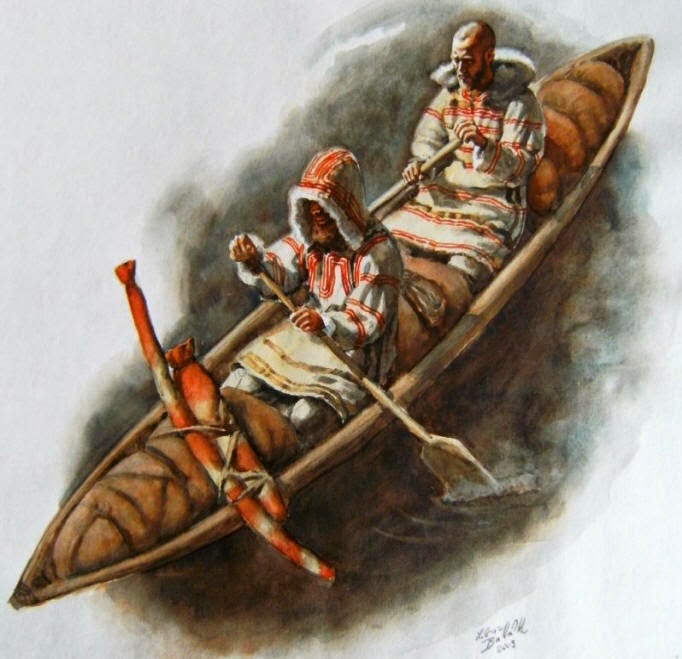
An illustration reconstructing the Neanderthals who left pigment splotches in teh cave at Pisecny Hill, near Becov, Czech Republic. By Libor Balak

Also found at the site is a certain scallop shell. While this is a normal find, this particular shell is very unique. One half of the shell has naturally occurring red pigment running across it in a horizontal band. The other side has lost its coloring, and Neanderthals replaced the red stripe with a stripe of orange pigment, obviously continuing the pattern. Not only is this the first actual evidence of Neanderthal painting, it shows a high degree of symbolism. Continuing a linear pattern shows a recognition of the object's geometry. The natural pigment is blended with artificial pigment to create a unique whole, neither just a shell nor painted lines, but a symbol.

The famous painted scallop shell, found at Murcia Spain made around 50 kya by a Neanderthal
Joao Zilhao

It is possible that these painted shells were worn as a necklace. Neanderthals did not pierce holes in shells, but did collect shells with small holes drilled into them by marine snails. Some of these shells have been found with pigment on them. While most people assumed that Neanderthals only collected these shells as an interesting manuport, recent evidence from a 2013 project by Bruce Hardy and others shows that Neanderthals did in fact have string. Microscopic amounts of unnaturally twisted fibers were found on the end of a stone point at a Neanderthal site in France dated to 90 kya. The 2nd oldest piece of string has only been dated to 30 kya and is obviously human-made. What exactly does this say about the symbolic life of a Neanderthal? Why would a Neanderthal have made a necklace in the first place?

[Speaking about human necklaces found at Blombos Cave in South Africa] “If...you ask yourself when is the first evidence for self-consciousness you don't really find it in those tools/hand axes. Perhaps you find it here in these beads, which are deliberately put around the neck or sometimes feet, and are deliberately used to be noticed by other people. I think they do ask the question 'How do I look in this?', and this question is clearly a question of self awareness.” -Colin Refrew

The microscopic piece of twisted plant fiber, found on a stone point at a Neanderthal site in France, made around 90 kya

Naturally pierced shells collected by Neanderthals, possibly worn as a necklace

A painted Neanderthal, by Mauro Cutrona
A Neanderthal with body paint and a shell necklace

A Neanderthal reconstruction by Viktor Deak

"Neanderthal Study", by soulty666

A 2012 study by Clive Finlayson and others found that Neanderthals intentionally removed the feathers from certain birds. The distal wing bones of raptors (specifically vultures and eagles) were targeted in this manner. The wings of these birds do not have much meat, and the systematic cut marks are dissimilar to cuts from butchery or disarticulation. The conclusion is that Neanderthals were removing feathers specifically for a non-utilitarian purpose, probably for ornamentation. The color of these feathers were mostly dark or black, and while many birds have been found with these cut marks this phenomenon is limited to caves in Gibraltar and the Fumane cave in northern Italy. It is possible that only certain groups of Neanderthals had developed this cultural trait, although corvid and raptor bones are strongly associated with many Neanderthal sites across Eurasia. “We don't think it's a coincidence that so many modern human cultures across the world have used them.” -Clive Finlayson. The interest in black feathers mirrors the Neanderthal interest in black manganese pigment, whereas early humans more commonly used red pigment. “What our ancestors liked about red these Neanderthals...liked about black...It means they had color symbolism. They were able to imbue colors in their natural world with some kind of arbitrary meaning.” -John Shea.

A sketch of a Neanderthal wearing one style of feathered ornamentation, by Antonio Monclova
A striking reconstruction of the La Chapelle-aux-Saints Neanderthal by Fabio Fogliazza. While there is evidence of clothing, body paint, and feather ornamentation, there is not evidence of ear piercing (earliest evidence of this practice is by humans), hair coloring, and shaving. Although early human societies without sharp razors did shave, either with stone tools or by plucking out the hairs individually

The reconstruction in profile

The reconstruction full-on. Around its neck is a raptor claw which have been found at Neanderthal sites in France. Claws have been found with cuts not made by butchery or by the bird itself, and presumably the claws were used in a symbolic manner by Neanderthals (according to the 2012 paper by Eugene Morin and Veronique Laroulandie)

A-ha! I bet you thought Fabio's reconstruction was only CGI! The model is actually an exhibit at the Museum of Human Evolution in Burgos, Spain
Clive Finlayson showing a possible feather decoration, the ulna was removed and the piece prepared using only flint tools

The Artistic Tradition

“A purely utilitarian kind of person does not put on a feathered headdress.” -John Hawks. So the question remains, what does the Neanderthal artistic tradition tell us about their mind? No utilitarian object stays utilitarian for long. Hand axes become symmetrical, colorful, and adorned with fossils – imbued with new value and traded up to hundreds of miles. Grinding hollows become cupules, created in a repetitive time consuming ritual, evidence of a deeply held symbolic belief. Pigment used for hafting spears becomes body paint, showing pattern recognition and clan individuation. Mammoth tusks become parts of a house, personalized with ochre and intentional markings. Animal waste becomes a painted necklace or a feather adornment. Necklaces are the birth of fashion, dependent on an individual recognizing their own self-image and in a meta reversal, recognizing the group's image of themselves. The one is distinguished from the group, a true individual is created, one with private tastes and fashions. All of which requires a complex theory of mind. Even stones and sand are turned into a funerary slab and burned in a mortuary ritual. “There is no documentable difference in symbolic behavior between Neanderthals and modern humans at any given time period.” -Erik Trinkaus.

“You don't need to have shell beads, you don't need to have artifacts with graphical representation to have behavior that can be defined archaeologically as symbolic...burying your dead is symbolic behavior. Making sophisticated chemical compounds in order to haft your stone tools implies a capacity to think in abstract ways, a capacity to plan ahead, that's fundamentally similar to ours.” -Joao Zilhao


Neanderthals designed symmetry, fossils, and color into objects. These objects were made to be looked at, they were made to be not normal. A hand axe with a fossil in the center was designed to be seen as other compared to one without. Hundreds of cupules high on a wall were designed to be seen as symbols compared to grinding hollows. The cross markings on the Tata Pebble were designed to be seen as interesting as compared to unintentional cuts on butchered bones. What does it mean for a Neanderthal to design something out of the ordinary? It implies that they took into consideration the thoughts and minds of others. When a Neanderthal noticed the symmetry of an axe, or the paint on a shell, what were they looking at? What went through their mind? This brings us to...

The Neandering Mind

The Neandering Mind

This is completely speculative, we know Neanderthals had brains and must have had a mind...but was there a difference between their mental experience and ours? Axiomatically we are cut off from their inner life, but archaeologically we can parse out similarities. In the large scale evolutionary history of our genus, the personality traits of a Neanderthal and the personality traits of a modern human are two variations on a similar theme. We both experienced experience, an inner life exists for us as much as it existed for a Neanderthal. While definitively proving the existence of the Neanderthal mind is impossible at the moment, the fossil record can be used to infer important details. Analyzing specific circumstances of a Neanderthal's life can give us certain actions and happenstances which their mind had to encounter. Examining the physical life of a Neanderthal can show us what their mind had to overcome to survive, and possibly can show what their mind considered and thought about.

Pragmatism, Stoicism, and Bravery

“[Neanderthals had] tenacity, or dogged persistence. Neanderthals must have been able to complete their tasks while in pain or with diminished capacity.” -Thomas Wynn, Frederick Collidge. Crippled Neanderthals would live and thrive years after grievous injuries, and many would have to shrug off pain and discomfort to survive day by day. Neanderthals share this trait with their predecessors and ourselves, yet Neanderthal bones show more damage than our bones. Erik Trinkaus conducted a study to see if there was any correlation between Neanderthal bone damage and modern human bone damage. This would determine which modern behavior creates similar fractures. As it turns out, modern rodeo cowboys suffer the same level and types of damage as Neanderthals. Neanderthal life consisted of getting up close and personal with large animals, often resulting in injury or death. “Neanderthals had the ability to withstand the pain, discomfort, fatigue, and hunger that were part of their everyday existence...Death was a constant companion; Neanderthals faced their mortality every day...Neanderthals had a concept of death, and...it was clearly something that they thought about.” -Thomas Wynn, Frederick Collidge.

Related to pragmatism is the way Neanderthals treated a body after death. While some groups practiced burial including the building of monuments and rituals, others did not, and some simply pushed the bones away from their living space. While Neanderthals would have affection for a living member of their clan, once that member died some groups of Neanderthals lost their sentimentality. There is much evidence of nutritional cannibalism in Neanderthal culture, either of other groups or of their own group. Changing the way you treat a body, from an individual, to a source of food, is purely pragmatic and speaks to the utility of the Neanderthal mind. At Moula-Guercy cave a group of Neanderthals came upon another clan and killed 6 of their members, dismembering and eating them afterward. They cracked open their skulls to eat their brains, cut the meat off their bones and crushed them for the marrow, and cut out their tongues. This is the same practice that Neanderthals would have done to butcher their common food source, red deer. Treating another Neanderthal body in such a way is completely pragmatic, dependent entirely on the lack of food and the necessity of your group over another. This is indicative of the way a Neanderthal mind would have looked at the world, while developed enough to feel compassion for a relative, pragmatic enough to butcher another tribe's children for food. At the time, we shared this frightening sense of practicality, contemporaneous humans were just as cannibalistic. Even today, while we may not eat another tribe's children, we still kill them without mercy.

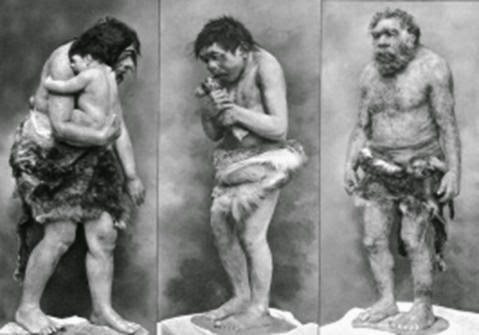
Only about 20,000 years off. An extremely inaccurate depiction of a Neanderthal from 1908, showing them to be savage and amoral brutes who are completely unrelated to the refinement and culture of the early 20th century

Pragmatism also covers the practical necessities of group living. Neanderthals, like the rest of our genus, relied on forms of grooming for social cohesion. With the development of complex language and abstract thought our genus was able to use absurdity, juxtaposition, and the exploitation of surprise, to tell a joke. The question is, when did this capacity develop? The evolutionary necessity for joke-telling increases as group population size increases. Once your tribe is larger than your immediate family (socially bonded by love), then an individual has to find another way to make connections. Since Neanderthal clans were only made up of their immediate family, it is possible that they did not share the need for complex social growth that their human neighbors did. Neanderthals may not have had the mental acuity to craft a joke, the ability to juxtapose seeming incoherent objects may have been outside of their mental reach, “they lacked either the motivation or the ability to make others laugh...” -Thomas Wynn, Frederick Collidge. While the abstraction and incoherent strangeness of human jokes may have been outside of their purview, absurdity through tomfoolery very much was a part of their life. The development of slap-stick comedy goes back to our chimpanzee ancestors, and certainly Neanderthals exploited this form of social bonding, “they may have had clowns who would make others laugh.” -Thomas Wynn, Frederick Collidge.

A reconstruction of a Neanderthal family in an American museum, 1930s. Covered in dirt and having severely bent backs you would have thought they never groomed and could not run anywhere. Neanderthals had leather, body painting, and personal adornments, they probably washed and kept clean. The ones found here with spinal problems were the elders of their group, and were cared for on a daily basis

Another practical problem of social life is genetic diversity. While not consciously an issue, it was certainly overcome since those Neanderthal clans who continued their lineage within the family died out due to inbreeding. All species in our genus and further back practice some form of out-migration. This is when a child leaves the group and travels to join another group, usually this practice is given a cultural reason but practically it helps spread the flow of genes. Usually the culture chooses who leaves the group, sometimes it is always male and other times always female. At one Neanderthal site, all the males in a clan were related, evidence that the migrants were female. Yet at many human hunter-gatherer sites, the females and especially grandmothers supply the most food from their local plant knowledge. Many societies which rely on the knowledge of females practice male out-migration. While it is not known whether Neanderthals practiced male or female out-migration, they most likely chose one – humans are the only species in our genus in which local culture selects the gender of the migrant, and some human cultures out-migrate both genders. Thomas Wynn and Frederick Collidge suggest that the practice of Neanderthal trading may not have been similar to human trading at all. Neanderthals may have given a precious stone to the out-migrating child, so as to ease the transition from one clan to another through gift giving.

“Neanderthals relied on families and the emotion bonds that bound them together. There was no need for cheater detection, which became advantageous only when non-emotional and contract-like agreements between acquaintances and even strangers became common...We suspect that Neanderthals' direct, emotional, embodied style of social cognition placed them at a marked disadvantage...The modern humans who entered...Europe...lived in larger face-to-face groups than Neanderthals did, maintained regular social contracts with acquaintances who lived hundreds of kilometers away, and almost certainly had the ability to negotiate with strangers, Neanderthals would not have known how to respond.” -Thomas Wynn, Frederick Collidge

While Thomas Wynn and Frederick Collidge put forth an interesting argument, it is times like these where the issue of what exactly constitutes the Neanderthal mind comes to a head. It is true, Neanderthals probably did not have the extreme level of social complexity which characterizes early human groups. That style of interaction is an evolution of a uniquely human social pressure to form bonds between large semi-related tribes. Although, to say that Neanderthals completely lacked some mental ability (such as the ability to detect cheaters) is going a step further. Simply because humans did it better does not mean that Neanderthals did not do it at all.

A reconstruction of the La Chapelle-aux-Saints Neanderthal, by the Field Museum of Natural History at Chicago

Since items were traded hundreds of miles through multiple clan's territories, there must have been some form of cheater detection. How could a Neanderthal understand the idea behind a trade without the requisite idea of being cheated? If one clan traded with another, then there was some form of a contract-like agreement, the ability to trade requires interacting with strangers in a level-headed and balanced manner. Besides trading, if Neanderthals did not do this, how did we end up breeding with them at all? Neanderthal out-migrating children would have been strangers to their new families, and Neanderthals had an institutionalized response to these newcomers (letting them stay). If Neanderthals “would not have known how to respond” how did their genetic pool stay diverse and healthy?

A reconstruction of the La Chapelle-aux-Saints Neanderthal in profile, by the Field Museum of Natural History at Chicago

Sometimes multiple clans would gather at a site for a grand feast, these clans were sometimes distantly related, and sometimes knew each other. Other times, they would not have been related, and would not have known each other. Yet at these sites clans cooperatively butchered large animals or hundreds of smaller game, divvying up the spoils without widespread violence then organizing the remains into specified piles. All of these actions require a significant amount of stranger and acquaintance interaction, including the possibility of cheating and being cheated. But these obstacles were overcome by Neanderthals, and multi-clan gatherings are not localized in any one area but are spread across the Neanderthal range. This is evidence that their cooperative capacity was not an isolated cultural tactic but was uniformly spread across their species.

Sympathy

Neanderthal bones tell us amazing stories of personal hardship and love. Crippled and paralyzed Neanderthals were given food by their family, and older members without teeth had their food chewed for them. It is impossible to understand why a Neanderthal would do such a thing without recognizing that they felt sympathy. Neanderthal families structurally operated in the same manner that some humans still do today, multiple generations living under the same roof all providing and caring for each other. “With a high mortality rate and few survivors past the age of forty, Neanderthal families extended to no more than three generations.” -Thomas Wynn, Frederick Collidge. The reasons why Neanderthals did this are twofold: Neanderthals loved and cared for their parents and grandparents, and Neanderthals relied on the localized knowledge which older generations had acquired. The first reason is spontaneous, and we can get a glimpse into how this felt simply by asking ourselves how does it feel to us now? While a Neanderthal's experience of love and affection was probably different in some capacity than ours, it was more similar to our experience than dissimilar. Human children love their parents, and human parents love their children – this evolutionary emotional connection held the same strength in a Neanderthal family as it does still now in human families (possibly it was felt by Homo Erectus as well). The daily struggle for survival which typified the Neanderthal existence put the same evolutionary pressures on practical teachable knowledge which still exist in human societies today. The knowledge of which fauna and flora were edible and which were dangerous was passed down from generation to generation, and probably went hand-in-hand with the knowledge of the Levallois technique and clothing creation. The ability for an elder to teach a child gives the entire species the capacity to inherit the knowledge of a single individual even after their death, this is an extreme evolutionary advantage.

Neanderthal facial models by the Senckenberg Institute of Natural History Collections, in Dresden Germany

It is remarkable that a Neanderthal would feed a parent who cannot feed themselves, if only because it seems so genuinely human. We can immediately relate to the experience of a Neanderthal in that position, the extreme hardship which humans go through to care for their aging parents was similarly experienced by a Neanderthal. The adult Neanderthals had to not only provide food for their children, but sometimes for their elders as well. Both Neanderthals then and humans now still haven't come up with a real solution to the problem of middle aged resource stress (unless you count nursing homes, which you shouldn't and you should feel bad for considering it). If Neanderthals cared so deeply for their family members while alive, it does not seem improbable that they would have grieved in their death. The construction of tombs and monuments shows that fond memories of a loved one continued on into the minds of the living, far after ones death. The construction of a place to go to which represents the deceased is also a strong indication of the emotion of nostalgia and emotional process of closure.

“They formed emotional bonds with family and band mates. Someone nursed Shanidar 1 back to health, and someone strived for weeks to keep Shanidar 3 alive, to no avail. Given the harsh conditions of Neanderthal life, this is evidence of a strong emotional attachment.” -Thomas Wynn, Frederick Collidge.

While complex story driven jokes may not have been in the purview of the Neanderthal comedic routine, that is not to say that comedy didn't exist in their society. Neanderthals, as with humans and all our ancestors, play. This often includes doing silly or absurd things, and physical comedy. While certainly Neanderthal children would have played in this manner, it is possible that adults too shared in comedy. Neanderthals physically could laugh and smile, and must have laughed and smiled at something. Exactly what they found funny or how they amused themselves is impossible to say, but all hominins including our ancestors did find something funny. The act of being silly around others usually indicates social bonding, comfort, and closeness. Neanderthals loved each other, and probably showed it in the same ways that we still do today.

“Neanderthals very probably could smile and laugh, and it probably happened when they were tickling each other, teasing, or playing. In fact chimpanzees laugh when they are tickled in the same places as humans, so Neanderthals probably laughed when tickled in their armpits and on their bellies and the bottoms of their feet.” -Thomas Wynn, Frederick Collidge.

Callousness

There are many examples of Neanderthals surviving upper body injuries, yet very few and practically no examples of surviving lower body injuries. This seems like an anomaly, since Neanderthals certainly would have acquired lower body injuries or amputations in combat with animals or in accidents. The Neanderthal fossil record shows that while an injured arm was nursed back to health, and injured foot was not. What exactly does this mean? What we know is that Neanderthals who did have lower body injuries were not brought back to camp and buried as others were. What would cause such an anomaly within the fossil record? Why were some Neanderthals nursed back to health and others were not? Thomas Wynn and Frederick Collidge suggest that Neanderthals probably thought along the lines of if you could not move with the tribe, then you were not cared for. Neanderthals who were injured in the field away from camp were either left there to die or were killed outright. When examined without context this practice seems exceptionally brutal and callous...if a Neanderthal had the tenacity to feed their aging parent for years why would they not care for one with a broken leg? It is possible that Neanderthals recognized that certain injuries were not treatable, and killed injured family members in a kind of mercy killing. For any human and for any Neanderthal this would have been a gut-wrenching decision and the phenomenon speaks more to their emotion of sympathy than to callousness. Even then, in the fossil record there is a lack of any attempts to care for lower body injures, even minor ones. Either Neanderthals ignorantly assumed that all lower body injuries were untreatable, or they callously executed family members for even minor foot or leg injuries. Both of these options seem unreasonably strange and foreign to us now, but within the context of their harsh existence it may have seemed like the reasonable thing to do. It is always possible that we will eventually discover burials with leg injures...but for the moment this strange blip in the burial record can only be explained through ignorance or callousness.

While Neanderthals loved their family, they were very willing to kill another's. While the archeological record contains evidence of large scale cooperative groups, the constant daily struggle of one clan against another has been rendered invisible. Yet this invisible inter-clan warfare was an inseparable part of a Neanderthal's life. While Neanderthal clans did not trade and interact with each other to the same degree as early human groups, these clans still fought over limited resources. Neanderthals certainly experienced interpersonal violence. The invention of the spear signals both the birth of big game hunting and the birth of warfare. While the evolution of large groups helped create the complex social web we live in today, it also allowed for a novel social interaction...war. Groups kill other groups, it sounds obvious but to understand a Neanderthal mind you have to understand this constant companion, and how strongly it was tied to their lifestyle. My clan is my family, my group...and your clan are outsiders, my enemies. This is another emotion with which we can sympathize, since we still do this all the time. Humans teach themselves to kill outsiders by removing any and all personal context from individuals. Once a member of different group is no longer a self-similar individual, but one part of a uniform blob of hostile intentions, they can be killed with little (at the time) damage to our sense of conscientiousness.

We have invented astounding ways around this problem of de-individuation. We actively insert other people's personal context into our daily lives. We can read about other people around the world simply by turning on the television, opening a newspaper, or going anywhere on the internet. The telephone allows us to talk to anyone anywhere...and while cynical philosophers love to tout that it has ruined human communication, it has also radically changed out definition of the other. Out-groups are no longer that tribe over there, but are speaking directly into your ear. Neanderthals did not have such extreme social luxury, they never saw outsiders on the newspaper or spoke to them on the telephone...outsiders were outsiders were outsiders. Neanderthals did not even have the complex trading connections that early humans did, which is a form of society that turns acquaintances into possible trading partners and eventually into possible friends. All of this evidence points to the fact that while it is easy enough for one human to kill another now, it would only have been even easier for one Neanderthal to kill another then. Humans are unique in that we can feel love and compassion towards someone not in our family or our tribe, people are outsiders only until we change our minds. Neanderthals probably could not do this to the extent that we can. Their family was their only in-group, everyone else was either a possible trading partner or someone to fight and kill.

No Autonoetic Thought

You might be asking yourself, what in the world is autonoetic thought? While it may not seem like a common personality trait and it is certainly not something which we come across on a daily basis...it is extremely common in humans. In fact, this trait is universal across all human cultures. What is this trait then? It is the recognition of an afterlife. All of us have such a recognition, regardless of our religion or lack thereof. We all understand that whatever the afterlife turns out to be, it will be different than the life here and now. Humans have taken this idea into consideration for quite some time, and this trait explains why humans around the world give such care to burials. This trait also explains why every religion includes some form of a life after life. So did Neanderthals think similar thoughts?

This question becomes difficult to solve when you want to know how people feel about the afterlife and you cannot ask them. The question becomes even more difficult when you are asking about an entirely different species. The most common archaeological evidence for this in humans are burials and grave goods. These phenomena give us an inclination that if we found these things at Neanderthal sites we could make similar extrapolations. Although this reasoning seems sound, we cannot absolutely know what made a Neanderthal build a tomb or construct a tumulus. While those activities in humans are representative of autonoetic thought, for other hominins they may only have been a memorial. They may only represent the once living, being unrelated to any idea of a life after that. Better evidence (in humans) of autonoetic thought is the presence of grave goods. Every human culture (until modernity) which left grave goods were preparing the dead for an afterlife. Yet even considering grave goods as presence of autonoetic thought is problematic. For other hominins, it is possible that the objects were only connected to the individual in life, if they brought memories of that individual or they were that individual's property. In that regard, Neanderthal grave goods may not show any thought about the afterlife as well.

While Neanderthals did (sometimes) make tombs or tumuli, sometimes they did not bury their family members at all. Neanderthals sometimes left grave goods, but when they did they left a couple stone tools or animal bones, most of the time they left nothing at all. While this is not direct evidence of any thought about the afterlife, it goes to show that Neanderthals had an idea about death which stands in stark contrast to our human notion. While it cannot be proven that Neanderthals did not have autonoetic thought at all, it was either not nearly as developed as in humans, or simply not there at all. The proof of this is found when comparing prehistoric human burials to the relatively simple Neanderthal graves.

An adult and two human children from the Gravettian culture were buried in Sungir Russia around 27 kya. By the time this burial took place, a sea change had occurred in the hominin mind. Here, we do see examples of autonoetic thought. One child was wearing leather clothing decorated with 3,000 beads, wearing a beaded leather cap, a painted stone pendant necklace, mammoth ivory arm bracelets, a belt with 250 fox teeth, a carved ivory animal pendant, an ivory sculpture of a mammoth, multiple ivory ornamental disks, and an ivory hunting spear. The rest of the group had dedicated hundreds of hours to preparing this one person for burial. While it is still possible that the ornamentation was simply a possession of the deceased, it is more likely that their culture had developed an idea of the afterlife. There is no other mental process which would compel people to spend so much time making things which would never be used except if they thought that the deceased would use those items in the afterlife. All of the ornamentation was preparing the individual for an afterlife, showing complex abstraction, imagination, and strong autonoetic thought. Other evidence for this is the fact that this child was buried with an ivory hunting spear. Ivory itself is brittle and would break after only one jab, contemporaneous humans did not use ivory for spears because it was commonly recognized as worse than flint or bone. Ivory spears are only found in burials. The ivory spear is worthless for the living, it is pointless to use in daily life...but it was included. The most reasonable explanation is that the deceased would have used it. This is evidence that they had a complex conception of the afterlife, not only was there hunting here but there was hunting there too. This is evidence that their afterlife included anything, evidence that their afterlife had meaning to them. If you enjoy hunting in this life, you will have an afterlife in which you enjoy hunting. This shows that their concept was imbued with meaning and connected to their culture.

The world's earliest non-controversial grave goods, from the burial at Sungir, 27 kya. On the left is a cloak pin, in the center is a horse figurine, and on the right is a strange disk. These items are sitting on top of the fox tooth belt
An illustrated reconstruction of the burial at Sungir, by Libor Balak. The graves are quite elaborate and show the development of autonoetic thought. The strange disk, which is seen here next to the head of the larger person, was fitted onto the end of a wooden lance, and was found sticking upwards when excavated. These disks may have been ornamental hilts or designed to prop up the lance, they true purpose and function are unknown

If Neanderthals did think that an afterlife existed, and if it included an individual who continued their living journey, its properties would alien to any human notion of such an afterlife. For Neanderthals, either grave goods were not transferred to the individual upon death, or objects were thought to be unnecessary for the individual in the afterlife. Since both of those ideas are not found in any human conception of the afterlife, either their idea was radically foreign to ours or simply they had no autonoetic thought. The concept of existence after this life is inherently tied to the human struggle to find meaning in an inherently meaningless world. A human who was a great hunter in this world, was given weapons so that they could continue hunting in the next. In the mind of that culture, hunting was given meaning outside of its necessary context. The tribe, then is given meaning too, as it is now the group's role in this life to give the deceased a proper burial and preparation. Giving a cultural meaning to hunting and to burial uses our ability to make abstractions to create self worth. It also shows that the tribe understands what that individual needs in the next life, showing an abstraction on their theory of mind. If Neanderthals had no autonoetic thought, they may not have found meaning to stretch past the life of an individual. That non-demonstrable abstraction which is the afterlife may have been, for a Neanderthal, unthinkable. If Neanderthals did experience autonoetic thought, their conception of it is, for us, unthinkable.

Conservatism, Xenophobia, and Close-mindedness

At the setting of the Neanderthal era, during the last few thousand years in which they lived on earth as genetically separate beings from ourselves – they invented the Chatelperronian industry. If recent dating evidence is held up, we could say for sure that Neanderthals independently thought up bone awls and ivory pendants. Even if this was the case, the Chatelperronian industry only stretches through parts of France and Spain and only lasts for a short period of time. It is a fascinating aberration from the dull normalcy of Neanderthal industry. In general, Neanderthals did not experiment. While Neanderthals did make the leap from Acheulean to Mousterian, once they reached that level they stagnated. For tens of thousands of years there was no innovation, no invention. It is almost inconceivable that millions of individuals lived for thousands of generations without changing nor improving on their technology. Well of course this is inconceivable for humans...there is something uniquely Homo Sapiens in our quest for advancement, in our undying curiosity about mechanics and generally everything. Neanderthals probably did not experience the notion of curiosity in the same way, or at least to the same fervent extent. Neanderthals strangely did not adopt human technology, even after contact. Some Neanderthals were even killed by atl-atls...yet no Neanderthal thought to use them.

“Neanderthals almost never came up with new ways of doing things. As important as it is to understand how Neanderthals might have innovated, it is important also to remember that they almost never did...This virtual absence is perhaps the single most important difference between Neanderthal technical thinking and ours.” -Thomas Wynn, Frederick Collidge.

Why did Neanderthals not innovate? It is impossible to pin that lack on any one particular issue. It was most likely a combination of factors stretching from situational circumstance to their innate mentality. On one hand, since there were so few Neanderthals compared to modern humans, the rate of invention was much lower. New individuals with new ideas were far and few between, compared to human bands. Even if new ideas entered one clan, how could they spread? With such small group sizes, a lack of large scale long distance trading, and possible extreme linguistic diversity...new ideas may have just petered out. It is possible that innovation was shunned, and inventions simply died with their inventors. Neanderthals probably shared a conservative and rigid view of their world. Their small group sizes and hostility to outsiders go hand in hand – products of their habits and minds as much as of their culture and lifestyle. If a clan encountered a new idea, it was probably rejected outright. A Neanderthal alpha may have valued tradition and familiarity over the risk of novelty. Compared to early humans, Neanderthals would be thought of as conservative, xenophobic, and close minded.


How would such a world-view become the dominant cultural trait of an entire species? It has a lot to do with the way one learns. “It is unlikely that Neanderthal children had more than a few active adults from whom to learn...a Neanderthal child...learned from watching a close relative.” -Thomas Wynn, Frederick Collidge. A Neanderthal child during youth was taught the Levallois technique of flake production. The child did not deviate from the technique, did not innovate, but mastered it as it was taught to them. Once that child became an adult, the technique was then passed down to another generation, and so on, for over 100,000 years. It is difficult to imagine how this could have been done, simply because humans act so radically different. Modern human youth is full of ideological plasticity, full of a constant yearning for the new and untried. While Neanderthal children may have shared a similar desire for personal betterment, that need was not fulfilled in the same manner. Youth was not marked by innovation and creativity, but by the adoption and replication of the proven techniques of your parents – any derivation from these proven tactics was seen as imperfect learning as opposed to inventive creation. 

The Last Neanderthals

The Last Neanderthals

Humans stand in stark contrast to the isolation and tradition of Neanderthal culture. Every human generation, like each Neanderthal generation, adopted the toolkit of its parents. Except for us there was one major distinction: humans always questioned this toolkit. We were and still are actively adding to the list of known technology. This is one of the many issues which mentally and behaviorally separate us from Neanderthals. While there are many commonalities in the psychological behavior of Neanderthals, the separation in cognitive power certainly gave us an advantage. Examining this separation is vital to understanding how a disparity in thought became a disparity in dominance. We are not only asking why they perished but why we flourished. That question involves every aspect of our bodies, genes, minds, lifestyles, and our environment. “The differences in their skulls suggest early Homo divvied up the environment, each utilizing a slightly different strategy to survive.” -Susan Anton. We certainly did have a different strategy to survive, yet this evolutionary tactic did so much more. What began as traits to aid in our survival, became our indomitable conquest of the world. This was not planned, there were no great wars or political shifts. It was done by the hands and the genes of each individual human. Yet our conquest was slow, for thousands of years we coexisted with Neanderthals living side by side. Why did these last hominins die out, what happened to them?

mtDNA-based simulation of modern human genetic expansion in Europe starting around 1600 generations ago. Neanderthal range in light gray, human range in dark gray
A late Mousterian Neanderthal. This Neanderthal is wearing elements of the transitional Chatelperronian culture, one which adapted some human symbolic outlets yet continued Neanderthal stone industry. By Libor Balak
The final remnants of the continent-wide Mousterian culture began to decline between 45-40 kya. This is probably when most Mousterian Neanderthals died out. Chatelperronian Neanderthals (as well as Chatelperronian humans) died out in France and Spain also around this time, 40 kya. This was the final chapter in Neanderthal culture, yet it is also the final chapter in our two species' contact. The first contact (physical and genetic) had already occurred tens of thousands of years earlier in Asia.

“Significant interbreeding between Neanderthals and early modern humans had probably occurred in Asia more than 50,000 years ago, so the dating evidence now indicates that the two populations could have been in some kind of contact with each other for up to 20,000 years, first in Asia then later in Europe.” -Chris Stringer.

For the life of a Neanderthal familial clan, over the course of thousands of years every day more and more of your territory contained large human hunting bands. We held a kind of power and dominance through our technology and our culture, and so complete was this dominance that Neanderthals could not overcome it nor rebound from it. The Mousterian Neanderthals who remained by 40 kya were pushed further and further into the badlands and onto the mountain tops of Europe. The Neanderthal eclipse was neither spatially nor temporally uniform, with some clans holding out in mountain refuges (called refugia) across Europe. At the moment, the presumption is that the final Neanderthals were in Europe, although the data for their decline in Asia is much more spare. For now, the evidence we have points us towards this European wane, and one such refuge is Gorham's Cave on the Rock of Gibraltar. The sight looking out from this cave may have been one of the last experiences of the living Neanderthal mind on earth.

Looking out from Gorham's Cave, Gibralter. It was at the time 5 kilometers from the seashore

A map of late Neanderthal holdouts (called refugia) in the Upper Paleolithic. Neanderthals may have continued in refugia such as Crimea, Croatia, southern England, and Iberia
Map charting the decline of Mousterian and the rise of Chatelperronian and Uluzzian. 45 kya Mousterian Neanderthals covered all of Europe. By 41 kya the last Chatelperronian Neanderthals had died out, and by 40 kya the only remnants of Mousterian culture (and Neanderthals) were in refugia. By 40 kya the dominant cultures in Europe had become Chatelperronian humans and Uluzzian/Aurignacian humans. From Tom Higham's 2014 study at Oxford

So what happened to the last Neanderthals? The most obvious answer is, in general, we happened. Human and Neanderthal contact changed their way of life, it disrupted their traditional habits and upended all aspects of their society. Anything that could have happened between us, probably did. There is evidence of both violence and interbreeding. Both of these factors are involved, as the reason for a civilizational decline is never within a single isolated issue but is spread across a range of internal and external factors.

The Economy of the Human Body

Examining the Neanderthal body in comparison to humans quickly reveals glaring differences in resource management. The most basic requirement for survival is food, and Neanderthals simply needed more of it than humans did. When we did eat food, we processed it more effectively than our evolutionary cousins. Some of the most important human-specific developments were in the conservation of energy, to fully utilize what we already had was more important than inventing new techniques. Excessive food requirements on Neanderthal communities put more pressure on their family clan structure to hunt and gather. This would have constrained the leisure time in which to think abstractly and innovate. The higher food requirement for Neanderthals also increased their dependence on their local environment. Any disruption to their food chain was uncontrollably disastrous. While a temporary collapse in a food source would cause starvation in the local human population, it would cause famine in the Neanderthal population.

“The explanation is found in the overall morphological change in the body biotype that prevailed in our species compared to our ancestors. The Homo Sapiens had a slimmer body, lighter bones, longer legs, and were taller.” -Researchers with Carretero Diaz. Processing food was done differently, but hunting that food was also radically different. This novel human strategy for taking down large animals was not to directly confront them, in contrast with the highly successful Neanderthal strategy. Our technique was truly innovative, slowly over the course of days, we walk them to exhaustion. All of these physical advantages (slimmer body, lighter bones, longer legs, taller height) are beneficial to this hunting strategy. “Larger legs, narrower hips, being taller and having lighter bones not only meant a reduction in body weight (less muscular fat) but a bigger stride, greater speed, and a lower energy cost when moving the body, walking, or running.” -Carretero Diaz. While trailing an animal, we could move at such a pace that the animal is always tiring itself, yet we were never fully exhausted. The economies of many physical systems in our bodies were improved, such as our thermoregulatory, obstetric, and nutritional systems. We could fully realize the beneficial potential of this strategy since overall our differences combined to give our species more endurance and energy than other hominins. Not was this strategy better suited for our biotype, but when humans came back from the hunt, we brought back not only surplus food but the hunters safe and sound. There was a much higher chance for a Neanderthal to not come back from a hunt. For humans, if a hunter was injured in a dangerous confrontation with an animal, it was out of the ordinary. Whereas for those Neanderthals who had been injured, it was a common result.

Changing Climate and Ecosystem

In relying so heavily on their environment for stability and food, the lifestyle of a Neanderthal was highly dependent on a regular climate. “Unstable climate conditions favored the evolution of the roots of human flexibility in our ancestors.” -Richard Potts. The disruption of this regularity may have contributed significantly to their demise. Around 55 kya weather began to fluctuate wildly from extreme cold to mild cold over the course of only decades. This put extreme evolutionary pressure on Neanderthals to adopt new techniques, not over the course of generations, but during a single lifetime. The inability for a single generation to adopt a radically different lifestyle would have contributed to their decline. This may have been the first serious bump on their road to success, and at this time humans and Neanderthals were in contact in the Middle East and Asia. Possibly these climatic pressures drove Neanderthals onto the same territories as humans, stirring up both conflict and interbreeding. The changing climate saw the native forests of Europe recede into grasslands, disrupting the common Neanderthal tactic of the ambush.

Not only was the weather fluctuating, but multiple super volcanoes erupted during the waning of the Neanderthal epoch. Francesco Fedele has found that around 39 kya at Campi Flegrei near Naples Italy, a supervolcano blotted out the sun for months to years. It was the largest in 200,000 years. Liubov Golovanova has found that between 45-40 kya two supervolcanic eruptions covered (at least) eastern Europe. These triple eruptions between 45-39 kya would have killed many Neanderthals and humans, but whereas human populations could rebound from such a disaster Neanderthals could not. One striking difference in our societies was that the Neanderthal population peaked prior 40 kya at only 70,000 individuals with only 7,000 females able to give birth. Even if Neanderthals in general could rebound, it is likely that their genetic diversity could not, forcing more and more Neanderthals to breed with humans and to eventually enter human society. The extreme and quick variations in the climate during this period peaked at around 30 kya, if any Neanderthals were alive by that time (which is unlikely), this final blow would have killed them off.

A normal volcanic eruption. A supervolcano would be significantly more devastating, especially if there were three which effected Europe between 45-39 kya

Violence

Neanderthals did not only die of starvation, but some were outright killed by humans. Violence occurred when Neanderthals and humans competed for resources, particularly around rivers and valleys. One such point of conflict was the Danube, one of the main conduits for the early human entrance into Europe. There is even evidence that near the city of Perg in Austria, a camp of Neanderthals and humans lived at the same time directly across from each other. At nearby fords both humans and Neanderthals could get to the over bank, and at these territorial boundaries they must have seen each other. They most likely did know about each other, and probably were in direct competition over local resources. When humans and Neanderthals fought, the evidence is left in scars on their bones. The burial of Shanidar 3 was killed by a wound in the ribs. Wounded somehow, this Neanderthal was treated by its family yet died weeks later most likely from infection. This was not just another hunting accident, this was a spear wound. Researchers have determined that no thrusted or thrown spear could have made such a gash. When multiple techniques of injury were tested, the only one which came close to imparting such damage was the atl-atl.

A diagram of an atl-atl cast

Atl-atls are themselves not a weapon, but an accoutrement which improves a weapon. They are in effect both an extension and an improvement on our previous technology. It is essentially a curved stick which is held in the hand. You place the butt of a javelin in a notch at the back of the stick. As you swing the stick, the power and velocity of the thrown spear is amplified significantly. This makes javelins more than just throwing spears, they become effective and powerful long ranged weapons. This invention drastically improves the range and accuracy of javelins. While this improvement very much helped early humans, Neanderthals were no feeble enemy. If Neanderthals or humans ambushed each other, the side which attacked first surely had a huge advantage, regardless of the atl-atl. Ambushes were the primary Neanderthal hunting tactic, and they used it effectively to kill humans as well as any other animals they fought.

If a group of humans and Neanderthals fought each other in the open, both sides had a multitude of weapons and tactics, although humans had a serious advantage with their atl-atls. Yet while crafting an atl-atl is easy, crafting a good javelin is not and each human may have only had one or a few. This gave humans the upper hand when at an extreme distance, since human weaponry had a longer range than Neanderthal weapons. Once Neanderthals had closed that gap, or we had ran out of javelins, the equation changed. Neanderthals also had throwing spears, and in combination with more muscle their spears had more power behind them. Any human which was hit by a Neanderthal javelin was surely mortally wounded. As the distance closed even further, Neanderthals and humans both had throwing sticks (or boomerangs) which could kill if directed at a vulnerable spot. These weapons were also made more deadly in the hands of the stronger Neanderthals. Once the two sides met and were within melee range, both us and them had spears, hatchets, knives, and hand axes. In personal combat, Neanderthals were more proficient at grappling but humans had longer reach and more stamina. If we could keep them at bay and survive the initial contact, we had a good chance of winning in a fight. If a Neanderthal could grapple or disorient us, a few swift hits and we were dead. Human tribes were 2-4 times larger than Neanderthal clans, giving us a numerical advantage in combat. Warfare was and still is a messy affair, with Neanderthals and humans having different advantages in different situations. All the while something gave us an advantage, be it our intelligence, atl-atls, numerical superiority, or all three. While we had an advantage in long range combat, Neanderthals had an advantage in melee. Any particular victory or loss against a band of Neanderthals was more likely due to individual circumstances than to any large sweeping change.

A sketch of a Neanderthal, by Ossai. Found on Emmanuel Roudier's Neanderthal Blog

In the end, our long term evolutionary advantage was probably only hunting and conserving energy better than strictly combat. Although once the Neanderthals' ecological niche disappeared, it is easy to see how a hunting party of 20 youth and adult humans armed with atl-atls on flat grasslands could decimate a mixed age clan of only 8-15 Neanderthals. Perhaps our hunting strategy did not change when confronting Neanderthals, and as if they were another herd of deer we walked them to exhaustion over the course of days. Finally the Neanderthal clan would come to a stop: terrified, exhausted, and in the open. The band of humans could easily surround them and kill them at range, then the Neanderthals were looted and eaten. A gruesome end to our cousins, yet for humans the first step towards our current world dominance. We no longer had to fear any animal, not even our closest evolutionary competitor.

Human Cultural Advantages

Some researchers, such as Steven Kuhn and Mary Stiner, argue in their paper Paleolithic Diet and the Division of Labor in the Mediterranean Eurasia that developments in early human culture contributed to the demise of Neanderthals. Since human dominance was achieved by a statistically higher birth rate, they argue that some cultural development must have favored the lives of women and children. Possibly this was the creation of the division of labor based upon gender.

“On the basis of zooarchaeological, technological, and demographic evidence...the complementary economic roles of men and women so typical of ethnographically documented hunter-gatherers did not appear in Eurasia until the beginning of the Upper Paleolithic. The rich archaeological record of Middle Paleolithic cultures in Eurasia suggests, by contrast, that earlier hominins pursued narrowly focused economies, with women's activities closely aligned to those of men with respect to schedules and territory use patterns...More broadly based economies, as indicated both by the faunal record and the increasing complexity of foraging and related technologies, appeared earliest in the eastern Mediterranean region and spread (with modification) to the north and west. The behavioral changes associated with the Upper Paleolithic record signal a wider range of economic and technological roles in forager societies, and these changes in adaptation may have provided the expanding Homo Sapiens populations with a demographic advantage over other hominins in Eurasia.” -Mary Stiner and Steven Kuhn.

For hunter-gatherer societies in which males only hunt, not surprisingly they end up dying more often than females. If prehistoric humans followed this hunting strategy, it would have been a serious advantage over Neanderthals. If Neanderthal hunting bands included women, pregnant women, or children, they would have been put in serious danger due to Neanderthals' close combat style. Although there is no surefire method to prove the existence or non-existence of gender roles during this period – when common injuries among Neanderthals are examined, 87% of their head and neck injuries (hunting injuries) occurred on males. This is evidence that Neanderthal males were the ones getting up close and personal with the large game they were hunting. Even if Neanderthal males were the ones to confront animals on the hunt, they may have brought women and children along, increasing their chances of accidental death or injury. In the end, to make statements about Neanderthal culture you have to point at things which are invisible in the fossil record. It is just as likely that some other cultural factor increased the reproductive rates of humans which was unrelated to the creation of gender roles.

First Contact

Models of both a Neanderthal (foreground) and a Homo Sapiens (background) at London's Natural History Museum (both of the actual models are life sized and completely nude)

Thomas Wynn and Frederick Collidge give a thrilling account of how Neanderthal and Human contact would have happened. It all starts with a young child, an out-migrant, entering the territory of another clan. This child brings rumors of strange creatures, they resemble ourselves but they are taller, dark skinned, wear tailored clothing, and are raggedly thin and poorly muscled. These creatures have strange heads, with diminutive features. This rumor may have been spread around one clan, maybe surrounding clans, but it eventually died out and was forgotten. Neanderthals had no impetus to discover who these people were, rumors of dangerous strangers may have only fomented feelings of fear and xenophobia. Hundreds, if not thousands of years later, the clan catches their first glimpse of these new creatures. First they see the hunting parties, huge bands of tall dark skinned men, using atl-atls and shooting spears much further than any Neanderthal had seen before. These bands roamed great distances to run down animals, in the process passing through many different clans' territories. Any animals injured yet able to escape, would be found by Neanderthals with broken bone and antler spear heads. Such tools were unknown in the (Mousterian) Neanderthal world. Neanderthals also saw other bands of humans, groups of only women and children. Gathering and using nets to catch small game, they hunted apart from the bands of men. Humans would build devices to trap animals and return later to harvest them. Neanderthals may have encountered these traps by accident, injured by an inconceivably complex contraption. What would they have thought, who would they have blamed? It must have seemed like yet another aspect of the world intent on killing them.

Two models of a Neanderthal and a human face to face. The Neanderthal model was created by a team of researchers led by Jez Gibson-Harris and with help from Viktor Deak. Humans at this time were probably not pale skinned

At some point, humans were no longer just a rumor. A Neanderthal spying on a band of humans would see them spreading their camps out across large portions of a cave, not only at the entrance. Humans would build giant fires, too large to fit food over, and when others were out hunting the older members kept these bonfires going. After a meal, humans would continue to sit at these fires and simply talk for hours. Telling long elaborate stories and keeping each others' close attention. Around such fires, humans would sing and dance, some even playing drums or bird bone flutes. If Neanderthals could understand music, hearing this would have been an ecstatic joy. If Neanderthals themselves made music, listening to human music would have been uniquely pleasurable. It gave them emotions which they either had never experienced or were not expecting. If a Neanderthal's conception of music was only the voice, hearing music from a piece of bone would have been awe inspiring. If Neanderthals were not musical, such noise was violent, frightening, and confusing. Melodies and harmonies which lacked meaning were an impossibly strange and alien phenomenon only associated with violent foreigners. Even if Neanderthals understood music and rhythm, to hear such a phenomenon at a distance would be absolutely terrifying. You had never heard such a thing before in your life, and had no reference as to whether it was a signal of safety or death. If you had previous bad interactions with humans, and associated the music with them...it signified your impending death. To hear war music from the enemy camp at night and to not even know what music is only amplifies its terror.

A human child next to a model of a Neanderthal at the Neanderthal Museum in Mettmann, Germany

Some (or all) humans carved ivory. People were spending hours to make a realistic miniature figurine. This would have been very puzzling to a Neanderthal...why would someone make it, what is its use? They would have no ability to even begin to answer these questions. If one was found by a Neanderthal, it may have been kept as an interesting object (a curio). If a Neanderthal did see such a thing, they either never thought to recreate it or only made it in wood. Most likely Neanderthals did not have a symbolic or narrative culture, and Neanderthal children would not have played with abstract toys. An ivory mammoth was used by human children within imaginary worlds, it was actor in a grand story with a beginning, middle, and end, complete with excitement and suspense. Maybe a Neanderthal child did not understand how to craft such a story. Maybe the Neanderthal mind could not turn a figure which represents reality into an actor which represents imagination. If Neanderthals did make figurines out of stone, they were uncommon, although if Neanderthals made figures out of wood they could have been as commonplace as at human camps. Thomas Wynn and Frederick Collidge assert that if Neanderthals did made carvings, it would have been figures of females. Regardless it would have struck a Neanderthal dumbfounded to use ivory, or to make a mammoth. At the moment it is more likely that Neanderthals did not make figurines, as such things are not found even at later Chatelperronian sites who extensively carved ivory trinkets. If that is the case, what would a Neanderthal have seen if they looked at an ivory mammoth carving? They may have seen it as what it is, a mammoth – yet without the human afterthought I want one. They may have seen something, without truly understanding what it was, maybe one step away from connecting the dots. Lastly they may have not seen anything at all. Since it was neither a shell nor a weapon it was too abstract. Maybe they were unable to connect an abstract image of an object to the corresponding image of that thing in real life.

Viktor Deak next to a model Neanderthal he helped create for the BBC

Former German Finance Minister Peer Steinbrueck at the Neanderthal Museum in Mettmann, Germany

Humans traveled long distances, with smaller groups of a only couple humans leaving their tribe for weeks if not months to travel. When these bands would return they brought with them strange foreign artifacts. Trade objects were treated as interesting not only for their utility but for their exoticism. Trade was a way of seeing the outside world, of satiating our curiosity of the unknown. In this environment of foreign trade and hospitality, strangers were not treated with outright suspicion. All of this was abnormal in a Neanderthal's daily routine. One day, a Neanderthal clan is approached by some members of a nearby human tribe. Lacking communication, both groups keep their distance. The humans, in an attempt to replicate their culture, leave trinkets on the ground and back away. These humans expect the Neanderthals to understand that they too should leave requisite items on the ground in an exchange of equal value. Hypothetically during a trade, Neanderthals would look at two objects and see in both of them some abstract judgment of what is it worth to me. they then make a quick cost-benefit analysis and decide if one object is worth trading for the other. Thomas Wynn and Frederick Collidge think that we are expecting too much from them. If Neanderthals did not understand that trades were between objects of equal value, they may have just grabbed what the humans left. To a Neanderthal this was obviously a gift. The humans, angered at this theft, may have confronted the clan, but that would have only led to violence and more xenophobia. While Neanderthals were able to trade amongst themselves, trading one precious stone for another, they could not handle the complexity of multiple variables. Humans wanted to trade a precious stone for X, Y, and Z, instantly asking questions of value which a Neanderthal could not understand. To make sense of and to find worth in confusing complexity is quite the human hallmark. If trading was unsuccessful maybe we had a tacit agreement to steer clear of each other, yet if it was successful it only inspired further human encroachment. All the while humans and Neanderthals were living in the same areas for thousands of years, besides trading what else happened during our two species' contact?

A wonderful cartoon of a Neanderthal and a human, sadly I could not find its source

That Other Kind of Interaction

If we ever had any tacit agreement with a Neanderthal clan, that agreement as with all treaties ever signed by humans would have been immediately broken. Humans are inherently opportunistic, and when your band meets new people many opportunities arise. There is a remarkable amount of evidence we interbred with Neanderthals, not only genetic evidence but fossil evidence as well. Gene flow from the Neanderthal population was strictly from them-to-us, and not the other way around. This means that any Neanderthal and Human offspring either formed its own band of hybrids or joined human bands. Hybrids may not have been accepted by xenophobic Neanderthals, showing not only their callousness but their inability to accept beneficial change. It is impossible to know if there was any one way in which humans and Neanderthals interacted, it was most likely a combination of all possible ways. Sometimes group interactions resulted in violence, and other times maybe simple trading was possible. If groups got to know each other, both humans and Neanderthals have a tradition of group-butchery projects, which is a great way to cement trust and build relationships. Possibly Neanderthals and humans fell in love with one another, forming mixed race clans (which were eventually adopted back into the human gene pool). Yet humans and Neanderthals did fight, and in warfare there is always sexual violence. Since matches were mostly between Neanderthal women and human men, it is possible that some hybrids were born from post-conquest debauchery. It is nice to know that there is evidence against this...since humans and Neanderthals at the time were cannibals, when a tribe was conquered they were all butchered and eaten.

The fossil record shows an interesting story, one of prehistoric Europe as a genetic and cultural melting pot of hominins. Every corner of the Neanderthal range includes sites of hybridization. One of the sites where Neanderthals and humans first crossed paths, Amud Cave in Israel, a Neanderthal skeleton was found exhibiting features of interbreeding. This Neanderthal was 6 feet tall and lacked the large brow ridge and other standard Neanderthal features. At Abrigo do Lagar Velho Portugal, a child who died around age 4 was buried with pierced shells and painted with ochre around 24.5 kya. This child is neither human nor Neanderthal, sharing a mosaic of both species' features in its cranium, mandible, dentition, and postcrania. Hybrids have also been found in Romania, a person who lived around 30 kya was found with anterior skull swelling, an occipital bun, and a particular muscle arrangement at the back of their jaw. All of these features were lost by humans before we left Africa, yet were added back into our population by mixing with Neanderthals. In northern Italy a hybrid skeleton was found who lived between 30-40 kya, yet humans entered (southern) Italy around 45 kya. Thousands of years after first contact and the last Neanderthal hybrids still existed. “We could interbreed with them, we could have fertile children, and...some of these children became incorporated in the human community, reproduced, and contributed to present day humans.” -Svante Paabo.

A reconstruction of a late Neanderthal child buried at Gibraltar, Spain

While Neanderthals and humans interbred seemingly everywhere, places like Spain, Italy, and the Danube basin had significant interaction. Southern Europe in particular was a hotbed of activity pun intended. Today, modern southern Europeans share more Neanderthal DNA than the average European, specifically the region of Tuscany Italy has the most Neanderthal DNA. Vindija cave in Croatia is a remarkable example of how humans supplanted Neanderthals. At first, Mousterian Neanderthals inhabited the cave. Then for a period Neanderthals here used a mixture of Mousterian and upper Paleolithic tools, showing a mixing of regional cultures. Then suddenly, the fossils switch and you find human Aurignacians. These early humans used a mixture of upper Paleolithic and Neanderthal technology. Thousands of years later, this early human toolkit morphed into the complex Gravettian, evidence that our march to world dominance picked up speed. We did not just enter Europe and wide Neanderthals out, our cultures mixed over the course of thousands of years. We did not hunt them to extinction, we merged with them. While some Neanderthals died from the changing climate, those who survived probably had to interbreed with us, slowly coming under the Homo Sapiens genetic fold. While we do not have uncontroversial direct proof of contact, “we don't have a site where we have a human and a Neanderthal buried next to each other...I'm still waiting for that.” -Erik Trinkaus, we do have many examples of indirect evidence. This evidence is found across Europe and Asia, there is no place where humans and Neanderthals did not interbreed.

Vindija Cave, Croatia

The First Humans in Europe

Over thousands of years, all separate hominins were either dead or re-adopted into Homo Sapiens. So who were these first humans? There are two competing theories as to how and when humans entered Europe because there were in general two transitional human cultures. Although researchers may argue over who was the first, both cultures contributed to the quick human dominance of Europe. The first theory posits that the Bohunician transitional culture was the first distinctively human industry in Europe. This culture is mostly found in central Europe (and most likely eastern Europe), evolving from the Emiran culture in the Levant. This culture would have spread from the mouth of the Danube around 48 kya, slowly continuing upstream until reaching their namesake of the Czech Republic. This culture used an advanced version of the Levallois technique, both mirroring and improving on Mousterian technology. Bohunician would have been a mix of cultures, sharing some traits from Neanderthal culture, and other traits from human culture. Regardless of whether Bohunician was the first, it was completely replaced by Aurignacian humans by 40 kya.

Libor Balak's depiction of the Bohunician culture. This piece is a mural created for the city of Brno, with help from historical consultants Miriam Fisakova Nyvltova and Petr Skrdla

Libor Balak's depiction of Bohunician stone spears. Bohunician stone points have been found made from hornblende and radiolarite

The eco-cultural niche of the Emiran industry and its derivatives. The Emiran (proto-Bohunician) culture is in green. The Bohunician culture is in red
Early human cultures in Europe. The Aurignacians (dark triangles) were found in Italy, southern France, and northern Spain. The Bohunicians (dark rectangles) were found in Bulgaria, Romania, and the Czech Republic. The non-filled in shapes show the full extent of industries. Diamonds show the range of Bohunician culture. Triangles show the range of Human or Neanderthal Chatelperronian. Circles and squares show derivative proto-Aurignacian cultures in southern Europe: The Uluzzian in Italy and S.I.L.M.P. in Spain
A forensic reconstruction of a woman who lived at Abri-Pataud France, 47-17 kya

The other theory posits that the first truly human industry was proto-Aurignacian. This culture evolved out of the Ahmarian culture also in the Levant, spreading into south-central and then south-western Europe (and possibly eastern Europe). This human culture also spread from the mouth of the Danube into central Europe, but also had branches going west into Greece and Italy around 45-44 kya. These proto-Aurignacians entering southern Italy developed their own culture, briefly existing as the Uluzzians. While Bohunician culture flourished in central Europe, proto-Aurignacians held the most fertile land in Italy, France, and Spain. The dawn of large scale human cultures did not immediately signal the end of Neanderthal ones. Around the time of the entrance of proto-Aurignacians into Europe, Neanderthals in southern France developed their Chatelperronian culture, either independently or from human inspiration. This separate Neanderthal culture flourished for thousands of years, with local humans also adopting it. While their end did not come immediately, all Neanderthal cultures had died out by 40 kya. If pockets in refugia did survive past this point, they had became outsiders in an human world.

An Aurignacian man with equipment who would have lived around 43-30 kya. This depiction is based on remains found in the Mladec locality in the Czech Republic. Although humans at the time had no invented bows, they had throwing darts possibly with fletching. By Libor Balak
Aurignacian bone spear points. The bone points were found near Olomouc, Czech Republic. By Libor Balak

A map showing the spread of Proto-Aurignacian, and its southern Italian cousin Uluzzian. Originating in the Levant around 47-49 kya, proto-Aurignacian spread into the Balkan Danube delta by 46 kya. From there, by 44-43 kya it had spread up the Danube and into southern Italy. By 42-41 kya it had spread through northern Spain, southern France, Italy, and eastern Europe. By 40 kya Aurignacians had populated the entirety of Europe

Disregarding which culture entered Europe first, both proto-Aurignacian and Bohunician existed side-by-side for a couple thousand years. What is certain is that around 41 kya proto-Aurignacian culture had metamorphosed into Aurignacian, and spread colonies across every part of Europe. By 40 kya Aurignacians had replaced all human derivatives, including any remaining Mousterian humans, Chatelperronian in France and Spain, Uluzzian in southern Italy, and Bohunician in the Czech Republic. Human culture had exploded, and came to dominate all competitors. Due to Tom Higham's research the final Mousterian Neanderthal lived around 41,030-39,260 years ago (95.4% probability), and J. J. Hublin's research has put the final Chatelperronian Neanderthal around 41.5 kya. During these crucial years, between 42-40 kya, humans were finally coming out from Italy and central Europe. During this time, they colonized the rest of western Europe, from England to Catalonia. This is presumably when the last Neanderthal of any culture died out, yet it is also the eclipse of Chatelperronian and Uluzzian humans as well. The dominant society was not only Homo Sapiens, but specifically Aurignacian Homo Sapiens. The period of European contact between Neanderthals and humans, which occurred between 45-40 kya, lasted about 250 human generations and took place around 2,000 generations ago. While the Aurignacian culture has been forgotten, this period has left its mark in our current genome.

Recent dating showing the end of the Mousterian period around Europe, from Tom Higham's research

Recent dating showing the beginning and end of the Uluzzian and Chatelperronian industries in Europe, from Tom Higham's research

The range of Aurignacian culture by 41-40 kya, having become the dominant human cultural industry in Europe
A German Aurignacian man carving the Lion Man of Hohlenstein Stadel, around 40 kya. By Libor Balak
The Lion Man of Hohlenstein Stadel, found in a cave in southern Germany, made around 40 kya

During this period of Neanderthal civilizational collapse, humans began to make unique art objects. The Lion Man is a beautiful example of one such artifact. The figure represented, the meaning, and the gender of the statue are unknown. We cannot know those fine mental details, what thoughts came to an early human's mind when they carved such a figure. What we do know, is that it is the earliest piece of anthropomorphic art in the world. This figure is significant because it is not real, whatever it is it's imaginary. A creature imbued with meaning unknown in the real world. Humans could make anthropomorphic statues and later would leave hundreds of miniature animal statues at their camps. The Neanderthal record contains neither. Figurines were not the only unique items produced during this time, between 43-40 kya the first cave paintings were produced (most likely by humans) in Iberia. Also between 43-42 kya Aurignacians in Germany were making bone and ivory flutes. This time could truly be called an Aurignacian golden age, yet the dominance of Aurignacian culture in the fossil record foretells the demise of our hominin cousins. While Neanderthals could adapt their Mousterian toolkit with Upper Paleolithic ivory and bone ornaments (the Chatelperronian culture), they could not make further innovations. It is this period in which human culture radically cleaves itself from Neanderthal culture, resulting in successive advancement and Neanderthal stagnation. Neanderthals may have survived through this period in refugia, but it is unlikely or so minor that it has not been found yet.

A figurine of a lion, made from mammoth ivory. Found at the Vogelherd cave in southwest Germany and also made around 40 kya

Libor Balak's depiction of the imagined Lion Man of Hohlenstein Stadel. This depiction represents not what it actually was, but shows us what we can imagine in such a piece. We can imagine combining a lion's head and a human body. This abstract unrealistic portrayal of a creature may have been unrecognizable to a Neanderthal

The earliest miners, Aurignacians in what is now Egypt. Such larger scale mining began around 38-35 kya. Illustration by Libor Balak

If any Neanderthals survived through the 30,000s, they would have been awestruck by the pace of human change. Between 33-22 kya a novel culture arose in eastern Europe, the Gravettians. This culture quickly spread from eastern Europe, supplanting the native Aurignacian toolkit. These new Homo Sapiens took symbolic culture to an extreme. Those who died were buried with high ornamentation, significantly more than their Aurignacian predecessors. People were buried in head to toe leather outfits containing thousands of interwoven beads. By this period, human camps commonly show the remains of high art, hundreds of ivory animals litter sites. These humans build larger structures, and at Abri Pataud a large house was 23 feet long by 10 feet across, containing 5 simultaneously active hearths. That is about 226 square feet of space, significantly more than the needs of one family. This culture intertwined abstraction and symbolism into their clothing and appearance. Humans began to give everything around them abstraction. This culture put an immense amount of time and effort into planning ahead, not only showing their intellectual acuity but their cooperative advantage over the Aurignacians. Such social complexity would have been lost on any possible lingering Neanderthals. Probably by the time Gravettian culture had complex dominance over Europe, the Neanderthals were a distant memory.


A Gravettian male wearing beaded clothing, showing the explosion in symbolic thought during this period. By Libor Balak
A Gravettian woman wearing a hat inspired by the Venus of Brassempouy, by Libor Balak

The Venus of Brassempouy, a Gravettian ivory statuette made around 25 kya. It is unknown whether the figure is wearing a type of hat or a type of hairstyle

An absolutely remarkable figurine made of mammoth ivory about 26 kya by Gravettians. It was buried with a man who died in his 40s near Brno, Czech Republic. It has a notch at the base of its head which allowed the head to swivel, its arms could move to. While the legs have not been found, they may also have been mobile. This piece is the world's earliest doll, and shows the extreme symbolic advances in Gravettian thought across Europe
A Gravettian family from Sungir Russia, wearing their burial outfits. A hypothetical log long house is in the background. In this picture, teh family are wearing elaborate beaded clothing which was found on their bodies at the burial site. Each bead took around an hour to make, and on the child's clothing alone there are 3,000+ beads. These ornate clothes were probably not their every day wear, and probably not made for them after their burial. Possibly the clothes were their formal wear which they were buried in. Their expensive clothing may also be a sign of their wealth, and the Sungir burial may be the first evidence in human culture of a material disparity. Illustration by Libor Balak
A Gravettian community. Gravettians at Sungir made large houses which would have been shelter to multiple families, although there is no evidence (as far as I can tell) of rectangular log houses. There is archaeological evidence of Gravettian housing, they would make multiple small oval stone houses or a single large oval long house, also made of stone. The earliest account of a log house is in the Bronze Age, yet it is conceivable that they would have been built much earlier. Illustration by Libor Balak
A Moravian Gravettian woman (29-25 kya) wearing a hat, by Libor Balak

Moravian Gravettians (29-25 kya) in a canoe, by Libor Balak
An artist's rendition of Magdalenian reindeer hunters. This culture existed from 17-12 kya in Europe. By this time, tens of thousands of years after the death of Neanderthals, humans had developed sophisticated hunting tools and commonly made cave paintings

Libor Balak standing in front of an exhibition he helped create, at the Archaeopark Prehistoric Museum in Vsestary, Prague